


By BiosafePro Editorial Team | Biomedical Waste Management Specialists
BiosafePro is a professional manufacturer and global supplier of medical waste management solutions, including a full range of sharps disposal containers certified to international standards. Our team works directly with hospitals, laboratories, distributors, and procurement officers across more than 30 countries.
Before purchasing any sharps container, verify that it meets your regional regulatory standard (OSHA 29 CFR 1910.1030, ISO 23907, or EN 13853), matches your facility’s waste volume and placement needs, and comes from a supplier capable of providing consistent quality with documented compliance. Everything below explains exactly how to evaluate each factor.
Why Choosing the Right Sharps Container Matters
Sharps waste — used needles, syringes, lancets, scalpel blades, and other pointed medical instruments — represents one of the highest-risk categories of healthcare waste. The World Health Organization estimates that unsafe injection practices and needlestick injuries cause approximately 1.7 million Hepatitis B infections, 315,000 Hepatitis C infections, and 70,000 HIV infections among healthcare workers globally each year (WHO, 2003; Preventing needlestick injuries in health care settings).
Selecting the wrong sharps disposal container is not merely an administrative oversight. An improperly selected container may lead to:
- Needlestick injuries — The leading cause of bloodborne pathogen exposure among healthcare workers (NIOSH, 2000)
- Cross-contamination risks — Inadequate containment allows pathogens to contact surfaces, personnel, and other waste streams
- Leakage of infectious waste — Non-leak-proof containers create regulatory and biohazard incidents during transport
- Compliance issues — Facilities using non-compliant containers face fines, liability, and accreditation risks under OSHA, Joint Commission, or ISO audits
- Increased disposal expenses — Oversized, undersized, or frequently replaced containers drive up operational waste management costs
Procurement professionals, laboratory managers, and distributors must approach this decision with the same rigor applied to any critical medical device specification.
1. Ensure Regulatory Compliance
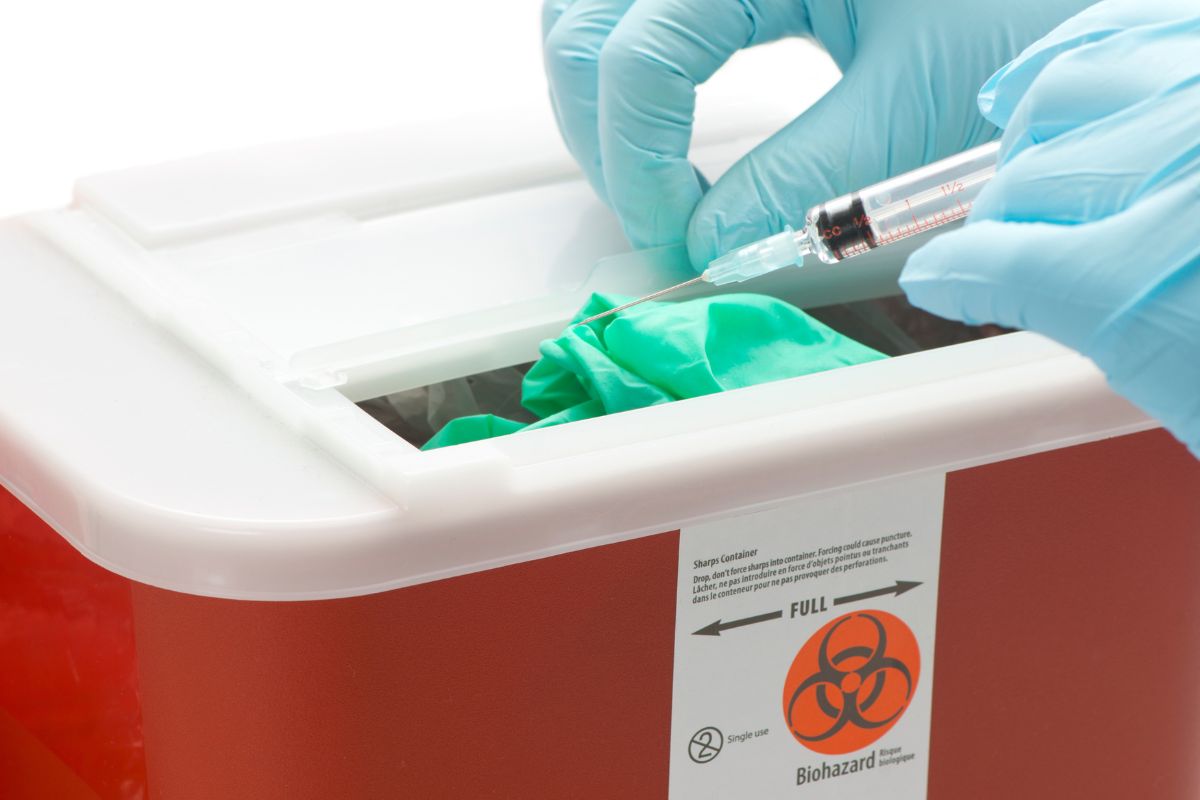
Regulatory compliance is non-negotiable. In the United States, sharps containers used in occupational settings must comply with OSHA Bloodborne Pathogens Standard (29 CFR 1910.1030), which mandates containers be closable, puncture-resistant, leak-proof on sides and bottom, and labeled with a biohazard symbol. For international markets, ISO 23907:2019 (Sharps injury protection — Requirements and test methods) and EN 13853:2017 (EU standard for sharps containers) are the primary reference frameworks.
A quality sharps disposal container should be:
- Puncture-resistant — Tested to withstand needle penetration; ASTM F2132 provides the standard test protocol for penetration resistance
- Leak-resistant — Sealed sides and bottom prevent fluid escape during handling and transport
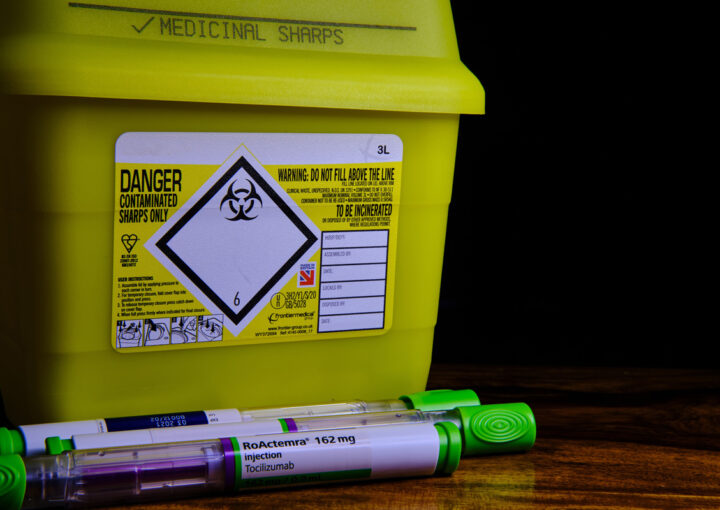
- Clearly labeled with biohazard markings — Per OSHA 29 CFR 1910.1030(g)(1)(i), labels must be fluorescent orange or orange-red with the biohazard legend
- Closable and secure after use — Both temporary and permanent closure mechanisms must function reliably under field conditions
- Designed to prevent hand entry — Opening geometries must block accidental or intentional reach-in access per ISO 23907 Clause 4.2
When evaluating sharps container manufacturers, always request copies of third-party test reports, ISO certificates, and any country-specific regulatory registration documents. Verified compliance documentation distinguishes professional-grade suppliers from commodity vendors.
2. Choose the Correct Container Size
Sharps container sizes are among the most commonly misjudged variables in procurement. Containers that are too small require frequent replacement and increase handling risk; containers that are too large may remain in service past their safe fill threshold, increasing the risk of overfilling — a documented source of needlestick injury.
The standard fill-line rule: containers should be replaced when waste reaches the fill indicator line, typically at 75% capacity, not when visually full (NIOSH Alert, 2000).
Overfilled containers are a serious safety hazard. Learn why in our clinical overview: Why Overfilled Sharps Containers Are a Serious Safety Risk.
Recommended Container Sizes by Facility Type
| Facility Type | Recommended Volume | Typical Container Format |
| Vaccination Station | 0.5 L – 1 L | Small portable sharps container |
| Outpatient Clinic | 1 L – 3 L | Desktop or countertop unit |
| Laboratory | 3 L – 5 L | Benchtop, wall-mount bracket compatible |
| Hospital Ward | 5 L – 10 L | Floor-standing or wall-mounted |
| Operating Room | 10 L – 23 L | Large capacity, bracket-mounted |
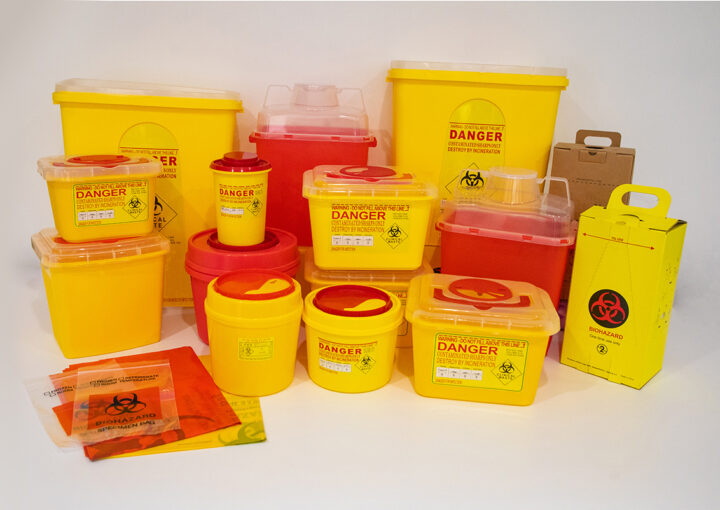
For facilities managing mixed sharps volumes — such as multi-specialty clinics or regional distribution centers — a full range of sharps container sizes should be available from a single supplier to ensure labeling, closure, and compliance consistency across the facility.
3. Evaluate Container Placement Requirements
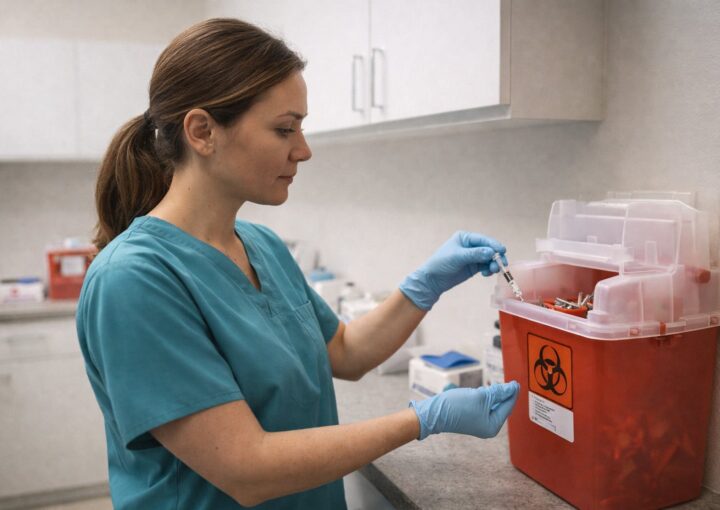
Where a sharps container is positioned is as important as which container is selected. Point-of-use placement — positioning containers as close as possible to where sharps are generated — is a core injury-prevention principle endorsed by OSHA, NIOSH, and the CDC.
Wall-Mounted vs. Portable Sharps Containers
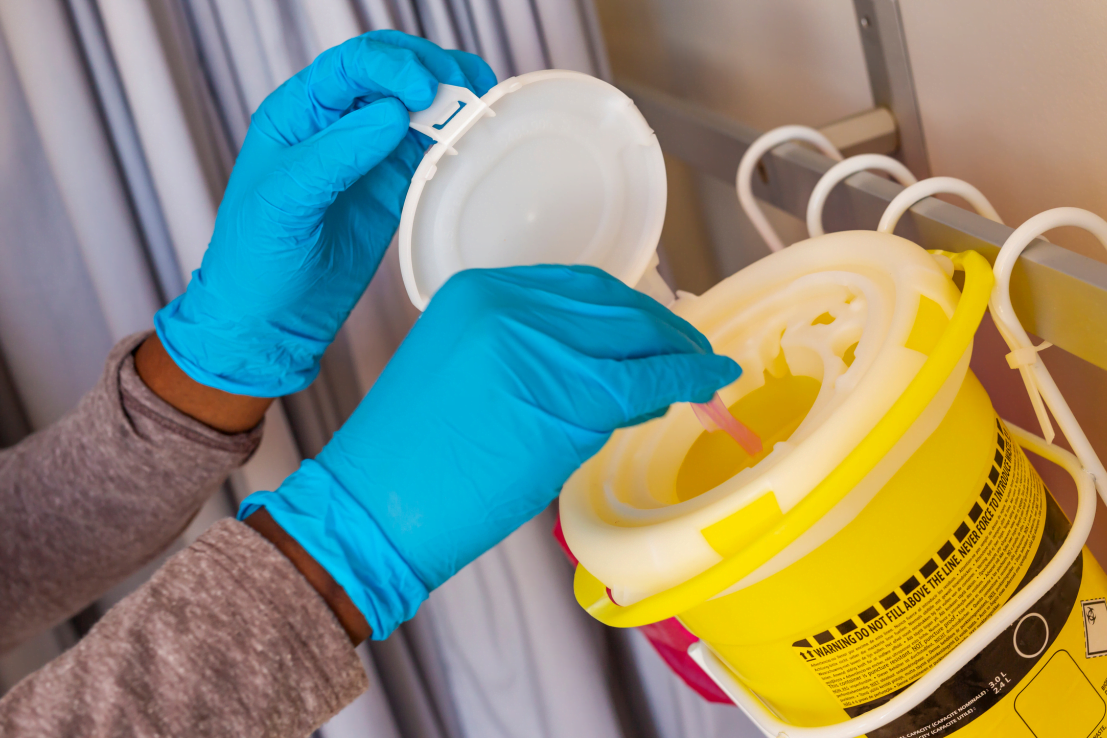
Sharps container wall mount systems are the preferred solution for fixed clinical environments:
- Maintains consistent height for safe one-handed disposal
- Reduces tipping and spill risk compared to free-standing containers
- Compatible with bracket systems that allow container swap without direct handling
- Ideal for treatment rooms, nurses’ stations, and procedure areas
Portable sharps containers are essential for:
- Home healthcare and community nursing programs
- Emergency medical services (EMS) and field teams
- Traveling vaccination programs and outreach clinics
- Laboratories with mobile workstations
A portable sharps container must meet the same regulatory standards as fixed units, with the additional requirement of robust lid-lock mechanisms to secure contents during transport. ISO 23907 Clause 6 addresses transportation testing specifically.
When procuring for a large facility, assess each clinical zone individually. A single-solution approach — using one size universally — typically results in mismatches that increase cost and risk.
4. Verify Safety Features
Not all sharps containers that claim compliance deliver equivalent safety performance. Buyers should evaluate specific mechanical features, not only certificates.
Key safety features include:
- Temporary Closure Mechanism — Allows the container to be partially sealed between uses, preventing accidental spills while the unit remains in active service. Look for single-hand operation capability.
- Permanent Locking System — An irreversible lock engaged before disposal or transport. Permanent closure must be tamper-evident and require no tools to activate.
- Wide Disposal Opening — Designed to accommodate full syringes, IV sets, and large-gauge needles without disassembly, reducing the need to recap or manipulate sharps before disposal.
- Anti-Needlestick Design — Geometric features at the opening — such as angled chutes, recessed ports, or one-way flaps — that physically prevent a needle from reversing direction and contacting the user’s hand.
For facilities comparing puncture resistant sharps containers, request ASTM F2132 test data rather than accepting manufacturer claims alone. Published test results from independent laboratories are the gold standard.
5. Consider Material Quality
The structural integrity of a sharps container depends on the polymer used in its construction and the quality of the manufacturing process. Material failures — cracking, splitting, or deformation — are responsible for a significant proportion of sharps container-related injuries that occur outside the clinical setting, during transport and waste processing.
- Durable polypropylene (PP) construction — High-density polypropylene is the industry standard for sharps containers due to its excellent impact resistance, chemical inertness, and compatibility with autoclave sterilization at 134°C (ISO 17665-1)
- High puncture resistance — Wall thickness and resin grade should be specified; containers tested to ASTM F2132 provide verified resistance data
- Leak-proof design — Welded or injection-molded seams with zero visible gaps; bottom integrity testing per ISO 23907 Clause 5.4
- Chemical resistance — Containers must resist disinfectants, blood, and pharmaceutical residues without degrading; polypropylene outperforms HDPE in chemical resistance profiles relevant to medical environments
For institutions managing reusable sharps containers programs — common in larger hospital systems seeking to reduce single-use plastic waste — material durability is even more critical. Reusable sharps containers must withstand repeated autoclave cycles, cleaning chemical exposure, and physical handling without structural compromise. Published guidance from the Association of periOperative Registered Nurses (AORN) supports reusable programs when properly validated (AORN Guidelines for Perioperative Practice, 2023).
For single-use applications, disposable sharps containers made from virgin polypropylene offer a cost-effective, contamination-free solution with no reprocessing requirements.
For a detailed breakdown of container types and their clinical applications, see: Sharps Containers Explained: A Guide to Types, Sizes, and Clinical Applications.
6. Assess Waste Management Efficiency
From a procurement and operations perspective, a sharps container purchase decision must account for the full lifecycle of waste management — not just acquisition cost.
- Container replacement frequency — Higher-volume wards may require daily or shift-based replacements; calculate annual units required based on waste generation audits, not estimates
- Storage requirements — Unused containers require secure, dry storage space; ensure your storage footprint is consistent with supplier packaging dimensions
- Transportation convenience — Containers shipped to disposal facilities must comply with UN 3291 (infectious waste) transportation regulations; verify that your selected container’s specification supports compliant packaging
- Compatibility with existing waste management processes — Containers should integrate with your facility’s waste stream segregation protocols, disposal vendor requirements, and any on-site treatment equipment (e.g., autoclave chamber dimensions for reusable programs)
Institutions operating at scale should also evaluate total cost of ownership (TCO), including labor for container changes, disposal fees per unit, and compliance audit costs — not only unit purchase price. A marginally cheaper container that requires more frequent replacement or generates compliance risks is rarely the economical choice.
7. Evaluate the Supplier, Not Just the Product
In regulated medical procurement, supplier qualification is as important as product specification. The proliferation of unverified sharps container manufacturers on global B2B platforms means buyers must perform due diligence beyond product catalogs.
A qualified supplier should offer:
- Consistent product quality — ISO 9001-certified manufacturing with documented quality management systems and batch traceability
- Regulatory documentation — Ready availability of CE marking, FDA registration (510(k) clearance where applicable), ISO 23907 certificates, and test reports
- Multiple size options — A full range of sharps container sizes from 0.5 L to 23 L+ to meet diverse facility needs from a single source
- OEM/Private Label capabilities — For distributors and regional brands requiring custom labeling, color coding, or specification modifications
- Stable international supply capacity — Verified production capacity, lead time reliability, and logistics infrastructure for sustained B2B supply
- Responsive after-sales support — Technical documentation, compliance assistance, and product issue resolution within defined SLA windows
BiosafePro maintains ISO 9001:2015 certified manufacturing, supplies to distributors and healthcare institutions in over 30 countries, and provides full regulatory documentation packages for all major markets. Our sharps container range is available in standard and custom configurations for OEM partners.
Learn what items are permitted — and what must not be placed — in a sharps container to ensure safe use and regulatory compliance: What Can Be Placed in a Sharps Container: Clinical Guide to Sharps Disposal Compliance.
Frequently Asked Questions
What size sharps container is best for a hospital?
Hospital environments require multiple sizes deployed by zone. General wards typically use 5 L to 10 L containers mounted on wall brackets at point of use. Operating rooms may require 10 L to 23 L high-capacity units. Phlebotomy stations and medication preparation areas commonly use 1 L to 3 L desktop units. A hospital-wide procurement should specify a complete range, not a single size.
What makes a sharps container OSHA compliant?
Under OSHA 29 CFR 1910.1030, a compliant sharps container must be: (1) closable, (2) puncture-resistant, (3) leak-proof on sides and bottom, and (4) labeled or color-coded in accordance with the standard. Containers must also be accessible at the point of use, not overfilled beyond the fill-line, and replaced and disposed of as regulated medical waste.
How often should sharps containers be replaced?
Containers should be replaced when waste reaches the fill indicator line (typically 75% of capacity) — not when visually overflowing. Additionally, containers must be replaced at defined time intervals regardless of fill level — commonly 30 to 90 days — to prevent degradation and contamination risk. Facility-specific protocols should be developed based on waste generation audits.
Are wall-mounted sharps containers safer?
Yes, in fixed clinical settings. Wall-mounted sharps containers offer consistent height placement, reduce tipping risk, and support single-handed disposal — all of which reduce the biomechanical conditions that lead to needlestick injuries. Studies published in the American Journal of Infection Control support point-of-use, fixed-mount placement as a key engineering control for needlestick prevention.
Conclusion
Choosing the right sharps container is a procurement decision with direct patient safety, worker protection, and regulatory compliance implications. The criteria are clear: verify compliance with applicable standards (OSHA 29 CFR 1910.1030, ISO 23907, EN 13853), match container size to actual clinical waste volumes, select placement formats appropriate to each care zone, and qualify your supplier — not just the product specification.
For laboratory managers, hospital procurement officers, and distributors building their product portfolio, the investment in due diligence at the selection stage prevents far costlier outcomes downstream — from needlestick incidents and regulatory non-compliance to supply disruptions and disposal inefficiencies.
BiosafePro offers a complete range of sharps disposal containers — from 0.5 L portable units to 23 L high-capacity systems — manufactured to ISO 9001:2015 standards and certified for global markets. Contact our team for product specifications, regulatory documentation, and OEM partnership inquiries.