By BiosafePro Technical Editorial Team | Biomedical Waste Management Specialists
BiosafePro is a specialized medical waste equipment manufacturer dedicated to environmental decontamination technology, high-temperature steam sterilization, microwave disinfection, and chemical treatment systems for healthcare facilities, laboratories, and regional waste management operators worldwide.
Evaluating medical waste microwave equipment requires verifying key performance metrics across disinfection efficacy, processing throughput, operational monitoring, and total cost per kilogram. Key industry performance benchmarks include:
- Microbial Inactivation Efficacy: Achieving a minimum 6-log10(99.9999%) reduction of Bacillus atrophaeus spores to verify microbial inactivation under full load conditions (Source: WHO Safe Management of Wastes from Health-Care Activities Guidelines).
- Throughput Accuracy: Validating actual operational throughput against nominal batch ratings, accounting for shredding duty cycles and internal loading bulk density (100– 150 kg/m³).
- Operating Temperature & Dwell Time: Maintaining a minimum uniform core thermal profile of 95℃– 100℃ for at least 30 – 45 minutes across all waste chambers (Source: UNEP Technical Working Group on Waste Management).
- Lifecycle Cost Efficiency: Evaluating average utility consumption, which typically ranges from 0.18– 28 kWh of electrical energy per kilogram of treated waste (Source: Healthcare Without Harm Environmental Assessment).
Selecting the right medical waste microwave equipment requires aligning manufacturer specifications with real-world operating conditions.
For a comprehensive overview of system engineering and deployment, explore our detailed analysis of the medical waste microwave treatment system process equipment and applications.
Treatment Efficacy: Can the Equipment Consistently Treat Medical Waste?
The primary objective of any medical waste disinfection process is the reliable inactivation of pathogenic micro-organisms. Evaluating microwave medical waste disinfection efficacy requires reviewing empirical testing data under standardized challenge conditions rather than relying solely on theoretical calculations.
Check Biological Indicator Test Results
The industry standard for confirming microwave treatment of medical waste efficacy relies on biological indicators (BIs). Standard validation frameworks specify a minimum 6-log10 (99.9999%) inactivation of resistant bacterial endospores, specifically Bacillus atrophaeus (ATCC 9372) or Geobacillus stearothermophilus (ATCC 7953) (Source: ISO 11138-1:2017).
- Challenge Spore Concentration: Test protocols require placing carrier strips containing at least 1 × 10⁶ spores inside the core of representative waste loads (Source: US EPA Health Effects Testing Guidelines).
- Inactivation Verification: Complete absence of growth after a 48-hour incubation period at 35℃– 37℃ confirms sufficient medical waste microwave treatment efficacy (Source: EN 285:2015+A1:2021 Standards).
Review Performance Under Maximum Loading Conditions
Evaluation protocols must test system performance under peak mechanical and thermal stress. Operating a medical waste microwave treatment system at 100% nominal fill capacity with maximum liquid content (15 – 20% liquid by weight) tests thermal energy penetration throughout dense waste matrices (Source: WHO Guidelines for Safe Healthcare Waste Management). Lower-tier systems often fail thermal mapping tests when challenged with high-density textile or liquid loads due to uneven microwave absorption.
Confirm Which Waste Streams Are Covered
Procurement teams must ensure that the equipment is certified for their facility’s specific waste composition. Standard medical waste treatment efficiency covers yellow-bag infectious waste, biohazardous sharps (scalpels, needles), anatomical parts (subject to local regulations), and laboratory plastics (Source: UN Basel Convention Technical Guidelines). High-performance systems integrate multi-shaft industrial shredders that reduce waste volume by up to 80–90% prior to microwave exposure, ensuring that steam and thermal energy penetrate dense waste items evenly.
Processing Capacity: Does the Actual Throughput Match Your Project?
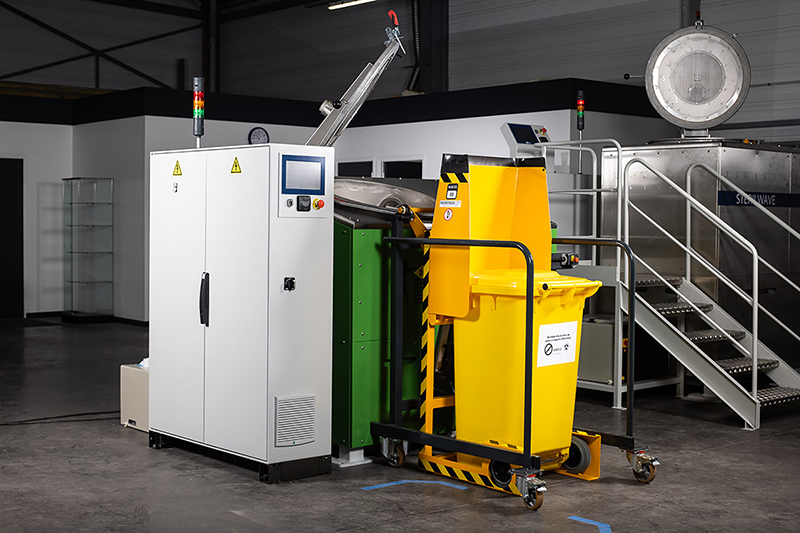
A common pitfall in healthcare waste management procurement is confusing theoretical batch ratings with operational medical waste microwave system capacity. Evaluating actual throughput requires analyzing loading times, internal bulk density variations, and cycle duration.
| Performance Indicator | What Buyers Should Verify |
| Rated Capacity | Whether the specification is expressed in kg/batch, kg/h, or another unit (Source: ISO 9001 Quality Management Guidelines). |
| Actual Throughput | The total quantity processed under standard daily operating conditions, accounting for sorting and loading. |
| Cycle Duration | The total time required for treatment, including automated loading, internal shredding, microwave heating, holding, and discharge steps (Source: UNEP Waste Management Guidelines). |
| Load Consistency | Whether performance and cycle times remain acceptable across varying waste densities (80 – 180 kg/m³) (Source: Healthcare Without Harm Technical Brief). |
Compare Rated Capacity with Daily Demand
To determine whether a medical waste treatment equipment model meets facility requirements, calculate the daily volume generation against operating window constraints using the standard hourly capacity formula:
Required Hourly Capacity (kg/h) = Total Daily Waste Generation (kg) / [Available Operating Hours per Day × 0.85]
An 85% operational efficiency factor accounts for mandatory daily maintenance, pre-heating routines, and material handling delays (Source: EA Engineering Waste Management Study). For instance, a hospital generating 1,200 kg/day within an 8-hour shift requires a system rated for at least 176 kg/h of actual processed throughput.
Ask for Throughput Data Under Realistic Conditions
Buyers should request third-party validation reports showing actual yield figures using standard hospital waste compositions. Standard municipal medical waste exhibits an average bulk density of 100 – 120 kg/m³ (Source: US CDC Environmental Infection Control Guidelines). If a vendor’s medical waste microwave equipment operating cost or throughput claim assumes an artificially high waste density (e.g., >200 kg/m³), actual operational capacity in hospital settings may fall 30–40% below quoted estimates.
Process Monitoring: Are Critical Operating Parameters Recorded?
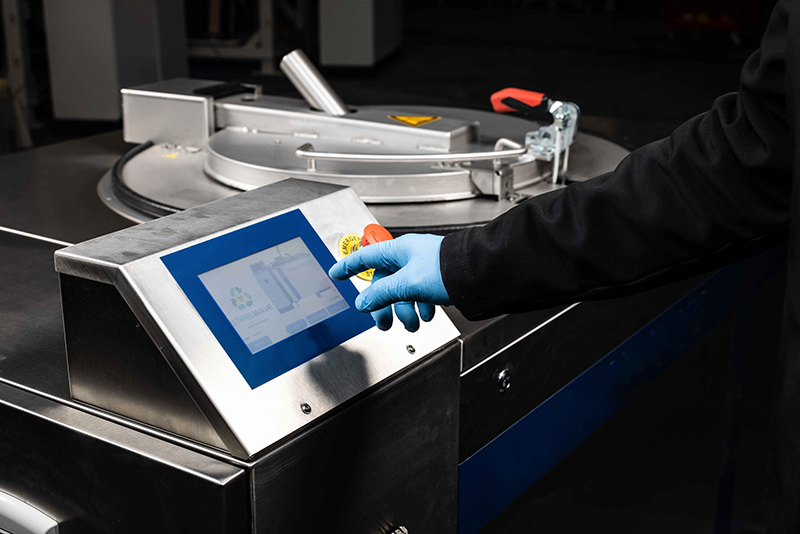
Comprehensive process monitoring is vital for regulatory compliance, environmental audits, and quality assurance. Modern medical waste microwave treatment validation relies on real-time sensor networks that track system metrics continuously throughout the operating cycle.
Temperature and Treatment Time
Effective medical waste microwave temperature monitoring requires multi-point temperature sensing across the internal disinfection chamber.
- Core Temperature Threshold: The internal chamber must achieve and maintain a continuous core temperature of 95℃– 100℃ for a minimum hold time of 30 – 45 minutes (Source: WHO Waste Management Directives).
- Sensor Distribution: Systems should utilize redundant PT100 resistance temperature detectors (RTDs) or infrared thermal monitoring arrays located in cold zones, such as discharge chutes and hopper drainage points (Source: IEC 60601-1 Medical Equipment Standards).
Alarm Functions and Operating Records
Programmable Logic Controllers (PLCs) must manage critical interlock logic during every medical waste microwave treatment cycle.
Which parameters are recorded automatically for each cycle?
The system must continuously log core temperatures, microwave output power (kW), total cycle duration, steam injection pressure (bar), and shredder motor current load at minimum 1-second intervals (Source: FDA Good Manufacturing Practice Guidelines).
What happens if a critical parameter falls outside its permitted range?
If chamber temperature drops below 95℃ during the holding phase, the PLC must immediately trigger an automated fault condition, extend the microwave radiation time, or fail the batch to prevent untreated discharge (Source: ISO 13485 Regulatory Framework).
Can operators retrieve historical records for quality checks, audits, or project acceptance?
Modern equipment must provide encrypted digital audit trails via USB export, integrated thermal printing, or cloud-based Ethernet connections compliant with 21 CFR Part 11 standards (Source: US FDA Technical Directives).
Treatment Uniformity: Does Performance Remain Consistent Across the Load?
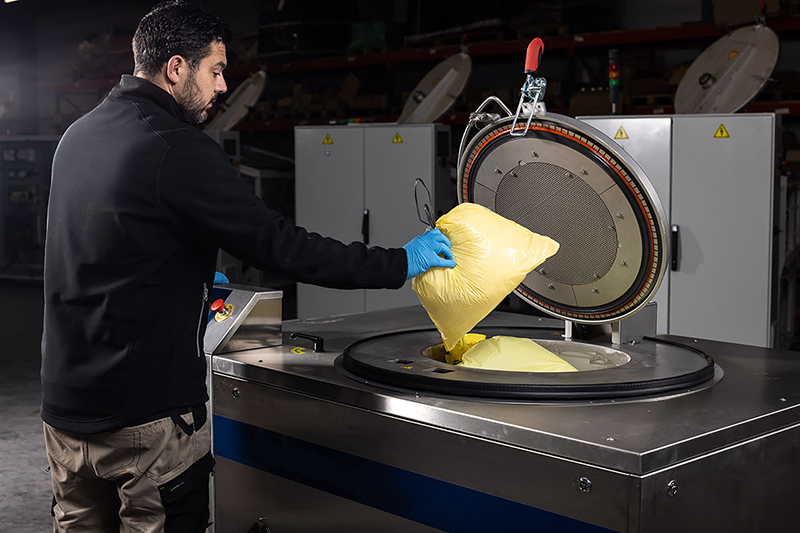
Achieving uniform microwave energy absorption throughout heterogeneous medical waste is an engineering challenge. Water molecules inside the waste absorb 2.45 GHz microwave radiation, converting electromagnetic energy into thermal energy. Without effective pre-processing, cold spots can form in dry or dense materials.
Evaluate the Pretreatment and Feeding System
Uniform heat transfer depends on effective particle size reduction and controlled moisture content prior to microwave exposure:
- Shredding Granulation: Integrated heavy-duty dual-shaft shredders should reduce waste into uniform particles smaller than 20– 30 mm (Source: EU Waste Treatment Directive 2008/98/EC). For detailed mechanical component specifications, see our engineering guide on inside a medical waste microwave sterilizer main parts explained.
- Steam Injection & Humidification: Injecting low-pressure saturated steam (1.5– 0 bar) humidifies dry plastics and textiles. Water molecules act as thermal conductors, enabling rapid, uniform microwave absorption throughout the load.
Check for Evidence of Uniform Treatment
To evaluate how to evaluate medical waste microwave equipment for uniform performance, ask suppliers for thermal mapping reports. Testing involves placing thermal indicator strips or thermocouples across at least 12 distinct points inside the treatment vessel. Temperature variations across all points must not exceed ±2.5℃ during the main exposure phase (Source: DIN 58946 Disinfection Standards).
Operating Efficiency: What Does Each Kilogram of Treated Waste Cost?
Calculating total operational expenditure requires analyzing energy efficiency, consumable consumption, routine maintenance schedules, and labor allocation. Evaluating medical waste microwave treatment performance from a financial perspective ensures project sustainability over a 10-to-15-year operational lifecycle.
| Cost Factor | What to Evaluate |
| Electricity Consumption | Specific power consumption per kilogram under standardized loading conditions (0.18–0.28 kWh/kg) (Source: Healthcare Without Harm Environmental Study). |
| Water and Steam | Water usage per batch for steam generation and shredder spray cooling systems (0.05–0.15 L/kg) (Source: World Bank Environmental Health Guidelines). |
| Consumables | Annual expenditure on biological indicators, chemical test strips, particulate exhaust filter replacements, and shredder lubrication. |
| Mantenimiento | Scheduled servicing schedules, shredder blade resharpening intervals (1,500 – 2,000 operating hours), and magnetron lifespan (8,000 – 10,000 hours) (Source: IEEE Industrial Electronics Study). |
| Labor | Full-Time Equivalent (FTE) staffing requirements for manual loading, automated bin washing, system monitoring, and processed waste handling (Source: WHO Waste Management Operational Manual). |
| Downtime | The financial impact of unplanned component failures, spare parts availability, and localized technician support response times (Source: ISO 55000 Asset Management Standard). |
Request Comparable Operating Data
Request standardized utility usage data measured under ISO or CE test conditions. Advanced systems utilize high-efficiency industrial magnetron modules and heat recovery systems to maintain total energy consumption below 0.22 kWh/kg. For healthcare facilities evaluating alternative technologies, integrated solutions like the BiosafePro Microwave Treatment System optimize magnetron output based on real-time thermal telemetry, lowering utility expenditures compared to conventional steam autoclaves.
Evaluate Serviceability and Spare Parts
- Magnetron Longevity: Industrial magnetrons rated for continuous operation should achieve an operational lifespan exceeding 8,000–10,000 hours before power output drops below 80% of nominal capacity (Source: IEEE Microwave Theory Guidelines).
- Shredder Blade Durability: Shredder cutters manufactured from high-grade alloy steel (e.g., Hardox 500 or D2 tool steel) extend maintenance intervals to 2,000 operating hours when processing standard hospital waste matrices (Source: ASM International Materials Handbook).
Performance Validation and Documentation: What Should the Supplier Provide?
A high-performance medical waste microwave treatment system must be backed by a complete technical and regulatory documentation package to support hospital accreditation and municipal environmental licensing.
| Document or Record | Why It Matters |
| Technical Specification Sheet | Confirms nominal capacity, utility requirements, physical footprint, and stated mechanical performance (Source: ISO 9001 Guidelines). |
| Performance Validation Report | Provides empirical proof of claimed medical waste microwave treatment performance under defined laboratory and field conditions (Source: EPA Medical Waste Directives). |
| Biological Indicator Test Results | Delivers quantitative evidence of 6-log10 microbial inactivation across bacterial endospores (Source: ISO 11138-1:2017). |
| Process Monitoring Records | Demonstrates continuous compliance with core thermal hold times and pressure parameters across historical batch logs (Source: FDA Good Manufacturing Practices). |
| Installation & Commissioning Plan | Defines setup, utility connection criteria, site safety acceptance testing (SAT), and operational qualification (OQ) protocols (Source: ISPE Baseline Guide). |
| Operation & Maintenance Manuals | Supports correct operation, routine servicing, and enables local staff to troubleshoot faults safely (Source: OSHA Workplace Safety Standards). |
| Quality & Conformity Documents | Helps assess compliance with destination market regulations (e.g., CE mark, ISO 13485 certification) (Source: EU Medical Device Regulation). |
Match the Evidence to the Intended Application
Procurement committees should ensure that third-party validation studies reflect their facility’s specific operating environment. Validation reports produced under dry, low-density test conditions may not replicate performance when processing high-moisture laboratory waste or heavy surgical sharps containers. To compare microwave processing against alternative sterilization frameworks, consult our technical evaluation of medical waste treatment microwave autoclave or incineration.
Review Tender Requirements Before Selecting the Model
Before finalizing an equipment order, match vendor documentation packages against local environmental protection agency (EPA) guidelines and hospital infection control standards. Ensure that certification documents carry accreditation from recognized international registrar bodies (e.g., TÜV, SGS, or UL) (Source: IAF Accreditation Framework).
Supplier Evaluation: Which Medical Waste Microwave System Is Right for Your Project?
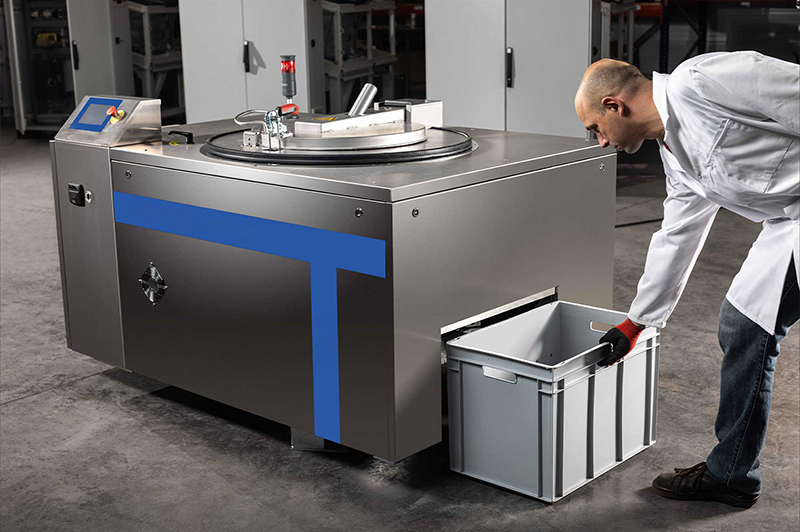
Selecting an appropriate system requires evaluating both hardware capabilities and vendor support services. Healthcare procurement teams should address three primary questions during technical tender reviews:
1. Does the proposed configuration match the workload?
Evaluate whether the equipment layout fits within your facility’s physical space and utility infrastructure. Review structural floor load ratings (typically requiring >1,500 kg/m²), electrical supply availability (380 – 480V, 3-phase, 50/60Hz), steam hookups, and compressed air availability (6 – 8 bar) (Source: NFPA 99 Health Care Facilities Code).
2. Can the supplier support project-specific requirements?
Determine whether the vendor can supply customized waste feeding mechanisms, automated bin lifters, HEPA air filtration systems, and carbon exhaust scrubbers to meet strict indoor air quality standards (Source: ASHRAE Standard 170 Ventilation of Health Care Facilities).
3. Can the supplier support long-term operation?
Assess the vendor’s spare parts supply chain, warranty terms, remote telemetry diagnostics, and local technical service response times. Leading equipment manufacturers maintain regional spare parts inventories and offer remote assistance to maximize equipment uptime.
Frequently Asked Questions
Q: How do you measure the performance of medical waste microwave equipment?
A: Performance is evaluated by assessing biological inactivation efficacy (achieving a 6-log10 reduction in Bacillus atrophaeus endospores), continuous operational throughput under standard waste bulk densities (100 – 150 kg/m³), internal temperature distribution uniformity (≥ 95℃ for ≥ 30 – 45 minutes), and specific energy consumption (0.18 – 0.28 kWh/kg) (Source: WHO & EPA Guidelines).
Q: Is microwave power enough to determine medical waste treatment performance?
A: No. Microwave power rating (kW) alone does not guarantee effective disinfection. Treatment performance depends on the combined interaction of pre-shredder particle size reduction (<30 mm), waste moisture levels, internal steam humidification, steam distribution, and overall chamber insulation.
Q: How can buyers verify the disinfection effectiveness of a medical waste microwave system?
A: Verification requires reviewing independent third-party laboratory validation reports that utilize biological indicator challenge tests (Bacillus atrophaeus or Geobacillus stearothermophilus strips containing ≥ 1×10⁶ spores) positioned inside maximum-density waste loads during standard operating cycles (Source: ISO 11138-1:2017 Standards).
Q: Why should medical waste microwave equipment be tested at maximum capacity?
A: Testing at 100% fill capacity challenges the system’s thermal dissipation capabilities, steam penetration, and microwave radiation distribution under peak mechanical load. Operating at full capacity ensures that cold spots do not occur within dense, moisture-heavy waste matrices during routine operation (Source: UNEP Waste Management Technical Guidelines).
Q: What is the difference between rated capacity and actual processing capacity?
A: Rated capacity is a theoretical benchmark based on uniform laboratory test loads or maximum volumetric hopper dimensions. Actual processing capacity reflects the true mass of standard, mixed hospital waste (100 – 120 kg/m³ density) fully disinfected per hour, accounting for shredding duty cycles, loading/unloading steps, and daily maintenance windows (Source: EA Engineering Technical Report).
About BiosafePro
Founded in 2010, BiosafePro is a professional manufacturer of environmental and medical waste treatment systems with over 14 years of industrial engineering expertise. Our comprehensive product portfolio includes advanced medical waste microwave treatment systems, autoclaves, and specialized shredders certified under ISO 9001:2015 and ISO 13485:2016 quality management standards. With CE-certified equipment operating across more than 35 countries in Europe, Asia, the Middle East, and Latin America, BiosafePro delivers reliable, sustainable, and cost-effective infection control solutions for modern healthcare facilities.
Ready to select or validate high-efficiency medical waste treatment equipment for your facility? Contact BiosafePro’s technical specialists today at for customized technical consultation, tender documentation support, and detailed project sizing estimates.
References
- World Health Organization (WHO). Safe Management of Wastes from Health-Care Activities. 2nd Edition.
- ISO 13485:2016. Medical devices — Quality management systems — Requirements for regulatory purposes.
- ISO 11138-1:2017. Sterilization of health care products — Biological indicators — Part 1: General requirements.
- United Nations Environment Programme (UNEP). Compendium of Technologies for Treatment/Destruction of Healthcare Waste.
- US Environmental Protection Agency (EPA). Guidance for Evaluating Medical Waste Treatment Technologies. EPA Technical Directives.
- European Committee for Standardization. EN 285:2015+A1:2021: Sterilization – Steam sterilizers – Large sterilizers.