
To dispose of needles at home safely, place all used insulin needles, syringes, and lancets immediately into a puncture-resistant sharps container after each use. Never drop them into regular household trash or recycling bins. When the container is full, seal it and return it through an approved sharps disposal program in your area.
What Is a Sharps Container?
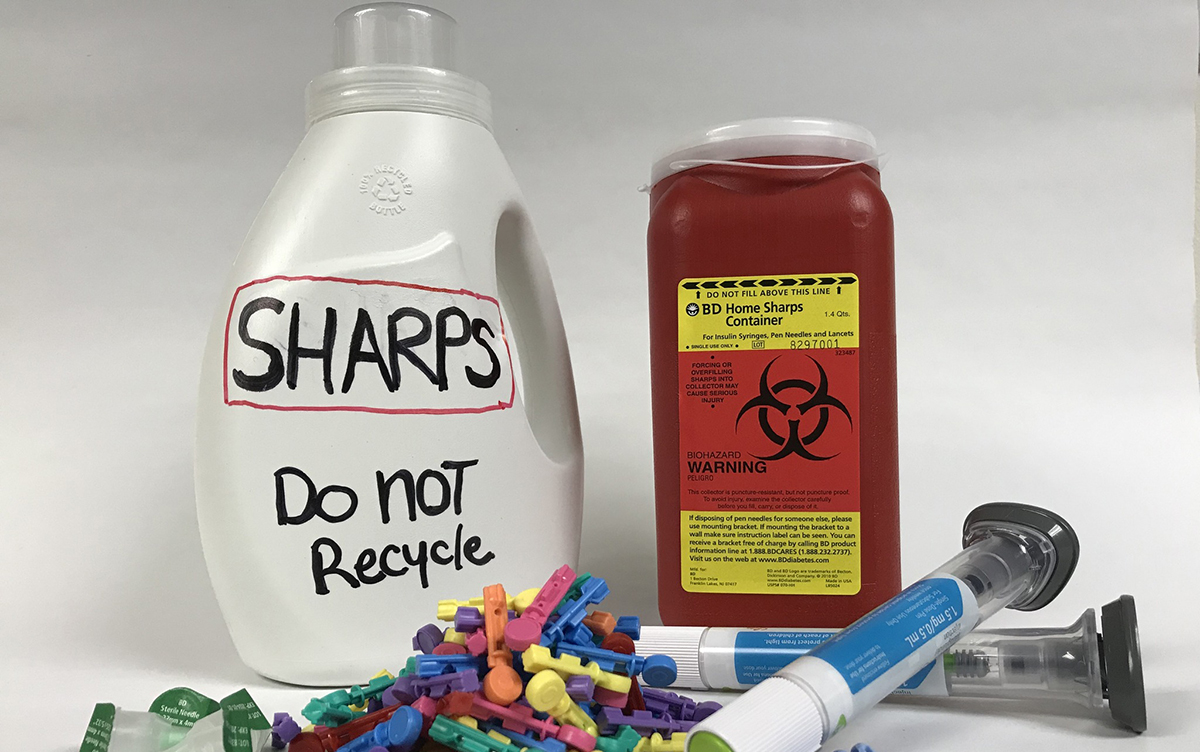
A sharps container is a puncture-resistant, leak-proof disposal box designed specifically for used needles, syringes, and other sharp medical devices. Unlike repurposed household containers, an approved needle disposal container is engineered to prevent needles from piercing through the walls, protect handlers from needlestick injuries, and contain any residual fluid safely until the container is professionally processed.
Most are made from high-density polyethylene (HDPE) and feature a one-way opening that allows sharps in but prevents them from falling back out. They come in a range of sizes — from compact 0.5L units for personal daily use to larger multi-litre containers for high-frequency injection regimens. Understanding the full range of sharps container types, sizes, and clinical applications helps you choose the right fit for your situation.
Why Is Proper Needle Disposal So Important?
Improper sharps disposal puts real people at risk — not just in theory, but daily. A loose insulin needle in a household bin can injure a child, a sanitation worker, or a family member within minutes of being discarded.
Risks go beyond your household
Waste management workers are among the most frequently injured by improperly discarded sharps. In the UK, NHS data consistently shows that needlestick injuries remain one of the leading occupational health incidents for refuse collection staff. In Australia, Safe Work guidelines specifically cite home-generated sharps as a known hazard in the general waste stream. In Germany, disposal regulations under the Kreislaufwirtschaftsgesetz (Circular Economy Act) treat household sharps as regulated waste requiring proper containment — reflecting a broader European standard that many countries have now adopted.
The potential consequences of a needlestick from a used diabetic needle include exposure to bloodborne pathogens. While the risk of transmission from a single home-use insulin needle is generally low, it is not zero — and the injury itself triggers a stressful post-exposure medical evaluation for the affected person.
Environmental dimension
Needles that enter recycling streams are virtually impossible to sort mechanically. They damage sorting equipment, contaminate recyclable material, and ultimately end up either in landfill or requiring manual removal — a process that creates further injury exposure. Safe needle disposal protects the waste system itself, not only the individuals handling it.
Legal and regulatory obligations
In many jurisdictions, disposing of sharps in regular household trash is not just poor practice — it is illegal. Local authorities in Canada, Singapore, the European Union, and most U.S. states have explicit regulations governing sharps disposal at home. Penalties vary, but the regulatory intent is consistent: home-generated sharps are a category of regulated waste, and households generating them are responsible for their safe containment and disposal.
How to Safely Dispose of Needles at Home: A Step-by-Step Guide
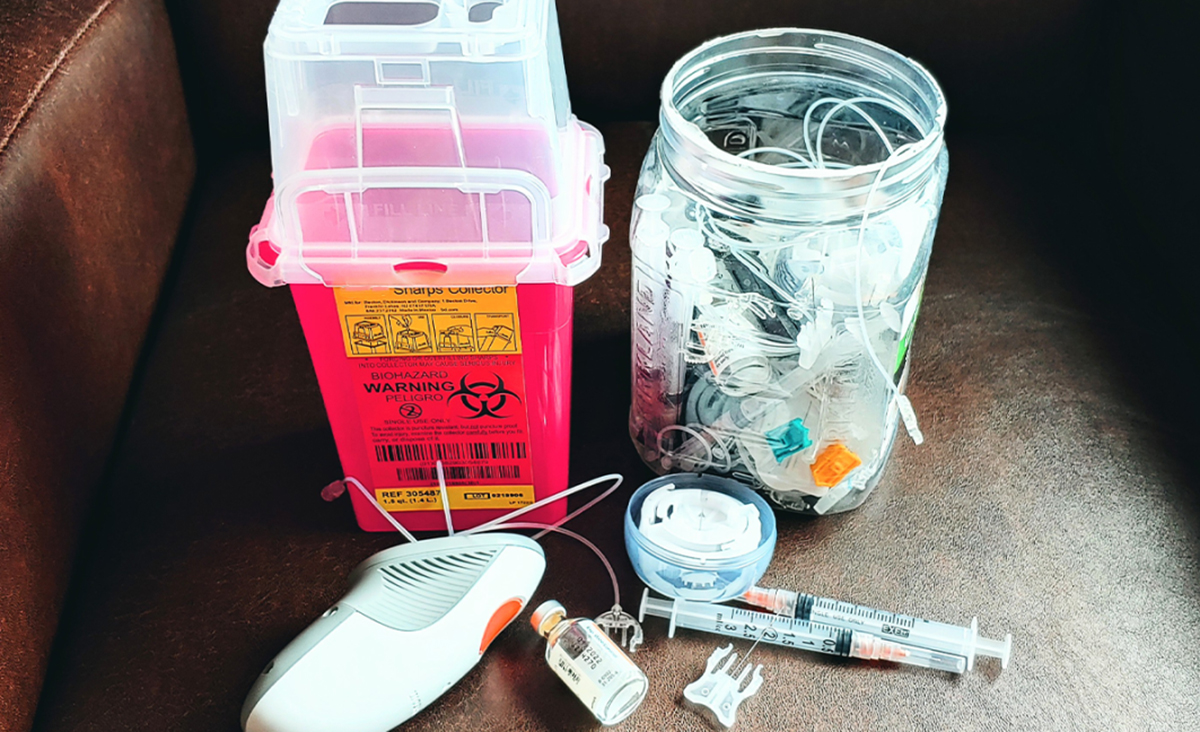
Safe sharps disposal at home is straightforward once the right infrastructure is in place. The steps below apply to insulin needle disposal, lancet disposal, pen needle disposal, and CGM inserter disposal.
Step 1: Set up your sharps container before your first injection
Place the container within arm’s reach of your injection site — a bedside table, bathroom shelf, or kitchen counter where you routinely inject. The container must be accessible at the moment of disposal, not stored in a cabinet across the room. Distance between the needle and the container is where most home needlestick injuries happen.
Step 2: Dispose of needles immediately after each use
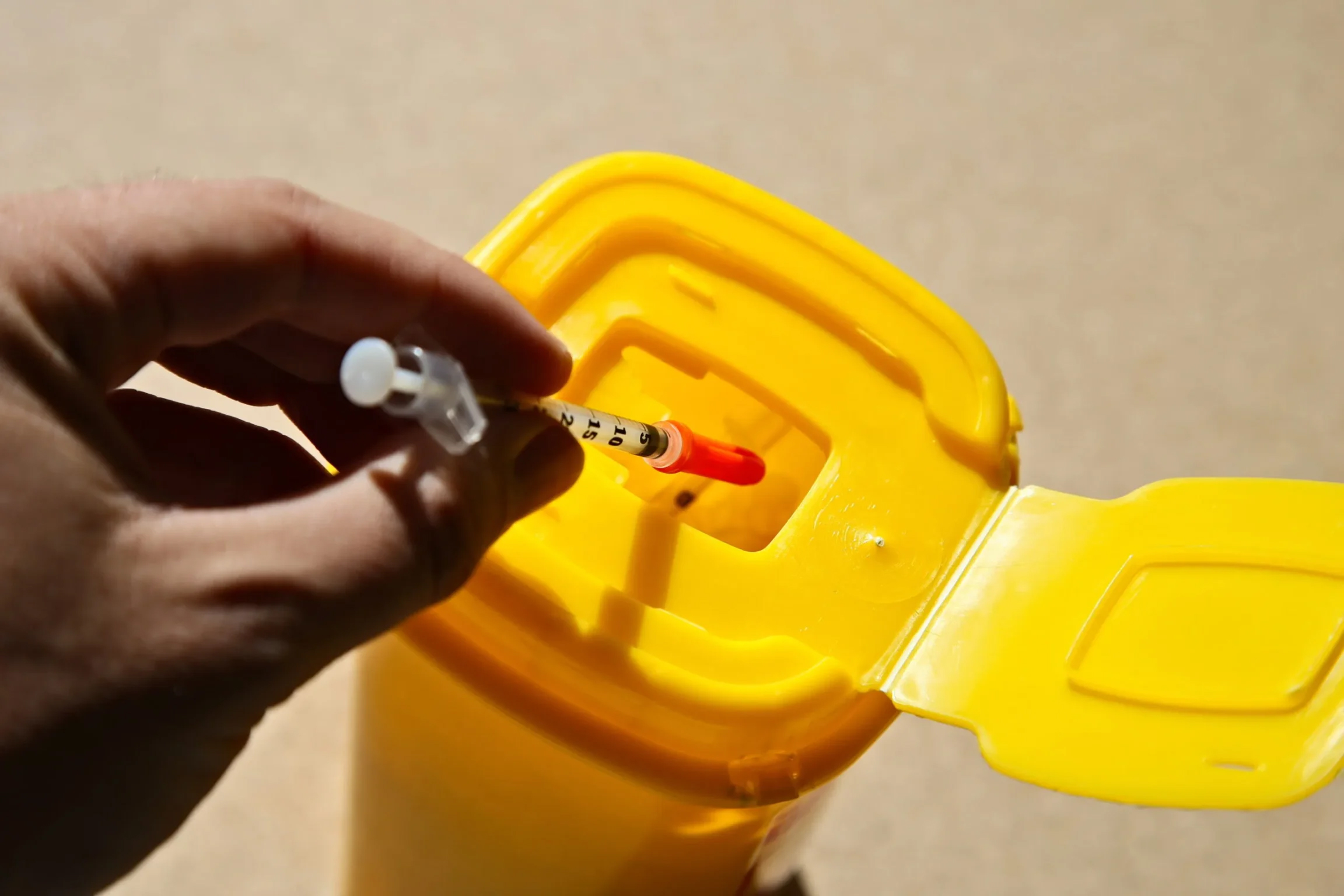
The moment after injecting, move the used needle directly into the sharps container — do not set it down on a surface first. For insulin pen needles, unscrew the outer cap and allow the needle to drop in without touching the tip. For syringes, insert needle-first in a single controlled motion.
Never recap a needle before disposal. Recapping is the single most common cause of needlestick injury in both clinical and home settings. The small coordination task of aligning a cap with a needle tip is where exposures consistently occur.
Step 3: Handle lancets as carefully as needles
Lancet disposal is often treated as a lower-priority step — lancets are small, the puncture is tiny, and the device looks innocuous after use. In practice, a used lancet retains the same pathogen transmission potential as any other used sharp. Dispose of lancets directly into the sharps container after every fingerstick test, using the lancing device to eject the lancet rather than handling it manually.
Step 4: Include CGM and pump components
Continuous glucose monitor (CGM) sensor applicators contain retractable needles that are not always visible to the naked eye once retracted. Insulin pump infusion sets also contain insertion needles. Both must go into the needle disposal container — not the general recycling bin, where their plastic housing makes them easy to mistake for non-sharp waste.
Step 5: Seal the container at 75% capacity
Fill the container only to the marked fill line — typically 75% of total volume. Once sealed, the container should not be reopened, compressed, or shaken. Label it clearly if required by your local disposal program.
Step 6: Dispose of the full container through an approved channel
Options vary by country and region (see the FAQ below), but approved pathways typically include pharmacy take-back programs, community collection points, mail-back services, and designated household hazardous waste facilities. Sealed sharps containers should never go into regular household bins, regardless of how securely they are closed.
Can Insulin Needles Be Thrown in the Trash?
No — in most countries, disposing of insulin needles in regular household waste is either illegal, a regulatory violation, or both. Even where enforcement at the individual household level is limited, the public health rationale is clear and the risk is real.
The argument that needles are “capped” or “inside a plastic bottle” is a common rationalization, but it does not hold up in practice. Improvised containers — soda bottles, coffee cans, detergent jugs — are not tested for puncture resistance under load conditions. When compressed in a waste truck or handled at a sorting facility, they frequently fail.
Diabetic needle disposal through regular trash is specifically prohibited under health regulations in the UK (Environment Agency guidance), Canada (provincial health authority regulations), Australia (state EPAs), Singapore (National Environment Agency guidelines), and across EU member states. In the United States, the FDA recommends against trash disposal and directs patients to community disposal programs, though state-level regulations vary.
The safest and most responsible approach is a sealed, approved home sharps container returned through a proper disposal channel — every time, without exception.
For healthcare facilities supporting patients transitioning to home injection regimens, the broader framework of medical waste containers and disposal categories provides useful institutional context.
Best Sharps Containers for Home Use: What to Look For
Does it meet recognized safety standards?
The baseline requirement for any home sharps container is puncture resistance — the container must prevent needle tips from penetrating through the walls under normal handling conditions. In the United States, look for FDA-cleared containers meeting 21 CFR Part 880 standards. In the EU, EN ISO 23907 sets comparable requirements. In Australia, AS/NZS 4261 applies. Regardless of which standard is referenced, the principle is identical: the container must contain sharps safely from the moment of disposal to the moment of final processing.
Avoid repurposed containers — including those commonly suggested online, such as thick plastic bottles or metal coffee cans. These are not tested to any sharps containment standard and offer unpredictable protection.
Is it the right size for your regimen?
Container size should be matched to injection frequency:
- Once-daily basal insulin only: A 0.5L–1L container typically lasts 2–3 months
- Basal-bolus regimen (4+ injections/day plus lancets): A 1L–2L container is more appropriate; a 0.5L container may need replacing every 2–3 weeks, creating additional handling risk through frequent transfers
- Multiple household members managing diabetes: A 2L–3L container is practical; wall-mountable options improve consistency
A container that fills too quickly encourages overfilling — one of the most common compliance failures in home sharps disposal.
Is the opening designed for your specific devices?
Not all openings are equivalent. Horizontal slot openings work well for pen needles and lancets but can be awkward for full syringes. Wider funnel openings accommodate syringes more naturally. Insulin syringe disposal is easier and safer when the opening geometry matches the device in use.
Does it have a secure, non-reversible closure?
A container with a lid that can be reopened after sealing creates risk — both from accidental re-access and from the temptation to add a few more sharps to an already-full container. Look for containers with a final-lock closure that cannot be undone once engaged.
Can it be used with your local disposal program?
Some mail-back programs require specific container brands or sizes. If you intend to use a particular disposal service, verify compatibility before purchasing the container.
What Are the Alternatives When No Sharps Container Is Available?
If a sharps container is not immediately accessible, a temporary improvised solution is acceptable — but only as a short-term bridge until a proper container is obtained. This is not a long-term disposal strategy.
Acceptable temporary options include:
- A heavy-duty plastic detergent bottle or bleach container with a secure screw cap and walls thick enough to resist casual puncture. Label it clearly as “SHARPS — DO NOT RECYCLE.”
- A metal tin with a tight-fitting lid (e.g., a paint tin or coffee can), sealed with tape. Metal offers better puncture resistance than most plastics.
These improvised containers should be stored out of reach of children, kept sealed between uses, and replaced with an approved sharps container for home use as soon as possible — ideally within 24–48 hours.
What should never be used, even temporarily: glass containers (breakage risk), thin plastic bags or zip-lock bags (no puncture resistance), cardboard boxes, or any container that cannot be securely sealed. Loose needles in any form are never acceptable, regardless of how briefly they will be stored.
Once you have obtained a proper container, transfer any sharps from the temporary container with extreme care — use gloves and tongs if available — and seal the improvised container before disposal. Do not attempt to transfer sharps by hand or pour them between containers.
Frequently Asked Questions
How full should a sharps container be before disposal?
Seal and dispose of a sharps container when it reaches the fill line — approximately 75% of its total capacity. Do not continue using a container past this point. An overfilled container is harder to seal properly, increases the risk of needles protruding from the opening, and is more likely to be rejected by disposal programs. Building the habit of replacing containers before they are completely full is one of the simplest ways to improve safe sharps disposal at home.
Can insulin pens be placed in a sharps container?
The pen itself does not go in the sharps container — only the detachable needle does. Insulin pen bodies are not classified as sharps. Once the needle is removed and disposed of in the sharps container, the pen body can be discarded according to your local regulations for pharmaceutical waste or standard household waste, depending on jurisdiction. Never place a full insulin pen, cap and all, into a sharps container — it wastes significant container space and is unnecessary.
Are lancets considered sharps?
Yes — lancets are sharps and must be disposed of in an approved needle disposal container. Despite their small size, lancets are classified as sharps by health regulatory agencies in every major jurisdiction. A used lancet can puncture skin and standard packaging materials, and it retains the same post-use biological status as any other used needle. Lancet disposal directly into the sharps container — at the point of use — is the correct and only recommended approach.
Where should I dispose of a full sharps container?
Disposal options vary by country and region, but approved channels exist in most areas:
- Pharmacies: Many pharmacies in the UK, Australia, Canada, and parts of Europe accept sealed sharps containers at no charge. In the UK, the NHS operates a community sharps disposal scheme through participating pharmacies. In Australia, the Sharpsmart and Daniels Health networks provide community drop-off services.
- Hospital or clinic collection points: Many outpatient diabetes clinics and GP practices accept sealed home sharps containers from registered patients.
- Mail-back programs: Available in the United States, Canada, and select European countries; the container is shipped to a licensed medical waste processing facility.
- Household hazardous waste (HHW) facilities: Most municipalities operate periodic or permanent HHW collection events that accept sealed sharps containers.
- Local health authority guidance: In Singapore, the NEA directs home sharps waste to specific collection facilities. In Germany, pharmacies and hospital waste collection services are the primary routes.
Always confirm local requirements through your national or regional health authority — regulations and available services differ significantly between countries and even between municipalities.
Can I travel with a sharps container?
Yes, but with important precautions. Most airlines permit sealed sharps containers in checked baggage and, in many cases, in carry-on luggage when accompanied by a prescription or medical documentation. The TSA (United States), IATA guidelines, and most national aviation authorities allow medical sharps for documented diabetic patients. However, policies vary — always confirm directly with your airline before travel.
When traveling internationally, research the sharps disposal at home regulations of your destination country before departure. Disposal services available in your home country may not exist at your destination, so carry enough container capacity for the duration of the trip. Some travelers use small travel-size sharps containers that fit within a standard toiletry bag. Upon return, dispose of the container through your usual home disposal channel.
Putting It All Together: Safe Sharps Disposal Starts With the Right Container
Managing diabetes at home means managing a continuous stream of used needles, syringes, and lancets — safely, consistently, and in compliance with local regulations. The decisions that matter most are made before the first injection: selecting the right sharps container for home use, placing it at the point of use, and knowing how to return it when full.
BiosafePro sharps containers are designed specifically for this environment — compact enough for home use, engineered to FDA and international safety standards, and available in sizes matched to different insulin regimens. Whether you are managing daily basal injections or an intensive basal-bolus protocol, there is a BiosafePro container designed to fit your routine without adding complexity to it.
For healthcare providers and institutions looking to support patients with compliant home disposal infrastructure — and to understand how home sharps waste connects to broader hospital medical waste management systems — BiosafePro offers guidance, product selection support, and bulk supply programs.
Contact the BiosafePro team to find the right sharps disposal solution for your patients or your practice.