


By BiosafePro Editorial Team | Biomedical Waste Management Specialists
BiosafePro is a professional manufacturer and global supplier of medical waste management solutions, including a full range of sharps disposal containers certified to international standards. Our team works directly with hospitals, laboratories, distributors, and procurement officers across more than 30 countries.
For hospital procurement officers, laboratory managers, and medical waste distributors, the question is never purely clinical — it is financial. Sharps containers represent a recurring operational cost that compounds across thousands of procedures, hundreds of beds, and multiple disposal cycles every year. Yet many healthcare facilities default to a single container type without ever conducting a rigorous total-cost analysis.
The answer to “disposable or reusable?” is not universal. It depends on your annual sharps volume, your contracted waste disposal rates, your labor model, and your regulatory environment. This article breaks down every cost variable so your procurement team can make the most defensible, data-driven decision.
What Is the Difference Between Disposable and Reusable Sharps Containers?
Before comparing costs, it is essential to understand what distinguishes these two sharps disposal systems at a structural and operational level.
For a comprehensive overview of container types, sizes, and clinical applications, see our guide: Sharps Containers Explained: A Guide to Types, Sizes, and Clinical Applications.
1.Material
Single use sharps containers (also called disposable sharps containers) are typically manufactured from high-density polyethylene (HDPE) or polypropylene. They are engineered for one fill cycle and are not designed to withstand sterilization or mechanical washing. Wall thickness is optimized for puncture resistance during use, not durability across repeated cycles.
Reusable sharps containers are constructed from heavier-gauge, impact-resistant polymers — often injection-molded polypropylene with reinforced locking mechanisms — that can withstand repeated autoclave sterilization or chemical decontamination cycles without structural degradation.
2.Life Cycle
A disposable sharps container has a single-use life cycle: it is delivered empty, filled to the marked capacity line, sealed, and sent for regulated medical waste treatment. Once sealed, it is never opened again.
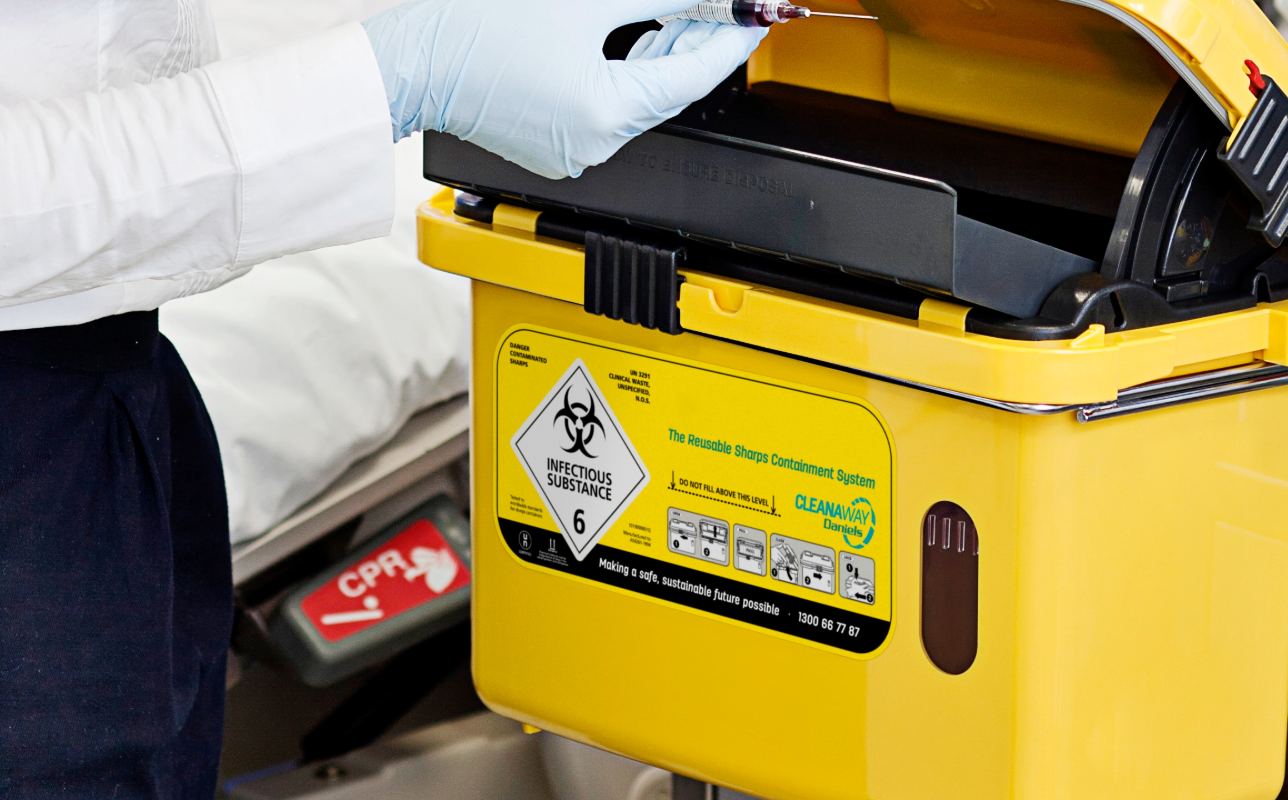
A reusable sharps container follows a closed-loop life cycle: delivery → use → collection by a licensed service provider → decontamination and reprocessing → return. Manufacturers typically certify these containers for hundreds of reprocessing cycles, with documented service lives of five to ten years or longer under normal clinical use.
3.Disposal Method
Disposable containers are treated as regulated medical waste. Depending on jurisdiction, they undergo incineration, autoclaving, or alternative treatment technologies before landfill disposal. The container itself becomes part of the waste stream.
Reusable containers are not disposed of after each use. The contents (sharps) are emptied under controlled conditions by licensed waste management personnel, and the container shell is decontaminated and returned to service. Only the sharps themselves enter the waste stream.
4.Collection Process
For disposable containers, collection is straightforward: full containers are sealed and placed in regulated medical waste bags or boxes for pickup by a licensed hauler. No specialized handling equipment is required at the facility level.
Reusable systems require a structured exchange program. A licensed service provider delivers clean, pre-certified containers, collects full ones, and manages reprocessing off-site. This requires coordination with a contracted sharps disposal system vendor and scheduled service windows.
5.Reprocessing
By definition, single use sharps containers undergo no reprocessing — they are treated and destroyed along with their contents.
Reusable containers are reprocessed according to strict protocols. In the United States, the EPA guidance document “Reusable Sharps Containers for Injection Drug Use Programs” and relevant state regulations govern decontamination standards. Internationally, ISO 23907-1:2019 (Sharps injury protection — Requirements and test methods — Part 1: Single use sharps containers for medical use) provides benchmarks, while ISO 23907-2 addresses reusable containers. Facilities should confirm that their reusable container vendor complies with applicable national standards.
6.Comparison Summary Table
| Feature | Disposable Sharps Container | Reusable Sharps Container |
| Use cycle | Single use | Hundreds of cycles (5–10+ year service life) |
| Treatment | Full container treated as regulated medical waste | Sharps extracted; container decontaminated and reused |
| Initial cost | Low per unit | Higher per unit |
| Waste generation | High (container + contents) | Low (contents only) |
| Typical users | Clinics, home care, low-volume labs, remote sites | High-volume hospitals, large laboratories, dialysis centers |
Comparing the Total Cost of Ownership (TCO)
Sticker price is the wrong metric. The only financially sound framework for evaluating sharps containers is Total Cost of Ownership — the sum of every direct and indirect cost incurred over a defined period (typically 12 months or a contract cycle).
1.Purchase Cost
Disposable sharps containers are inexpensive per unit — commonly ranging from $1 to $8 USD for standard clinical sizes (1–5 liter). However, a 200-bed hospital may consume thousands of containers per month. Annual purchase costs can reach $30,000–$80,000 or more depending on volume and container size mix.
Reusable sharps containers carry a significantly higher initial unit cost — often $15 to $60+ USD per container depending on size and certification level. However, because the same container is returned and reused, the annualized per-unit cost drops dramatically over time. A container used 200 times over its service life costs a fraction of a cent per use cycle.
2.Transportation Cost
With disposable systems, every full container is transported as regulated medical waste, which is subject to hazardous waste shipping regulations (in the US, DOT 49 CFR Part 173; internationally, IATA Dangerous Goods Regulations for air transport). Waste haulers charge by weight or volume — and the container itself adds significant non-sharps mass to every shipment.
Reusable container programs consolidate transportation: the same route delivers clean containers and picks up full ones. Because the container is not waste, return transportation may occur under less restrictive logistics frameworks, and overall transport costs per sharp disposed are typically lower in high-volume settings.
3.Medical Waste Disposal Cost
This is often the single largest variable in the TCO equation. Medical waste disposal costs vary dramatically by region, facility type, and contract terms — ranging from $0.50/lb to $3.00/lb or more in US markets (American Hospital Association, 2023 survey data).
With disposable containers, every pound of container plastic is billed at full regulated medical waste rates. A standard 1-gallon HDPE container weighs approximately 200–300 grams empty. Multiply that by thousands of containers annually, and facilities are paying premium disposal rates for polymer packaging, not just sharps.
Reusable systems dramatically reduce the regulated waste volume — and therefore the disposal invoice — because only the sharps themselves enter the waste stream. Studies published in Waste Management & Research (Rutala et al., referenced in CDC sharps safety guidelines) suggest reusable container programs can reduce overall sharps-related waste volume by 50–70% compared to single use programs in high-volume settings.
4.Labor Cost
Labor is frequently the most underestimated cost component in sharps disposal system evaluations.
Disposable containers require staff time for: monitoring fill levels, transporting full containers to staging areas, replacing with new containers, completing waste manifests, and managing inventory. In a large facility with dozens of container locations across multiple floors, this represents meaningful FTE allocation.
Reusable container programs shift much of this labor to the service vendor. Exchange programs handle delivery, collection, and reprocessing externally. Internal staff responsibilities shift toward scheduling and documentation rather than physical handling. However, reusable programs require disciplined coordination — missed service windows can leave full containers without replacements.
5.Replacement Frequency
Disposable containers are replaced at fill capacity — once. Reusable containers may remain in service for years, but they require scheduled maintenance checks and eventual retirement when structural integrity is compromised (per manufacturer specifications and applicable ISO standards).
In high-volume departments (emergency departments, surgical suites, dialysis units), the replacement frequency for disposable containers is very high, which amplifies every per-unit cost in the TCO model. Reusable systems absorb this volume without proportional cost increases.
When Do Reusable Sharps Containers Save More Money?
Reusable systems deliver the greatest financial advantage in the following scenarios:
- High-volume, centralized facilities: Hospitals with 100+ beds, dialysis centers, and large reference laboratories generate enough sharps volume to justify the per-unit premium and service program costs. The TCO break-even point typically occurs within 6–18 months for facilities disposing of more than 500 containers per month.
- High medical waste disposal rates: Facilities in markets with disposal costs exceeding $1.50/lb see compounding savings from reduced waste mass.
- Strong sustainability mandates: Reusable sharps containers reduce plastic waste generation substantially — a meaningful consideration for facilities pursuing Joint Commission Environment of Care objectives or ISO 14001 environmental management certification.
- Long-term contract stability: A reliable service provider partnership enables volume pricing and predictable budgeting across multi-year procurement cycles.
When Are Disposable Sharps Containers More Cost-Effective?
Single use sharps containers remain the better economic and operational choice in specific contexts:
- Low-volume or distributed settings: Rural clinics, home healthcare providers, mobile vaccination programs, and outpatient offices with modest sharps volumes cannot achieve the scale needed to justify reusable system infrastructure.
- Regulatory or logistical barriers: Some jurisdictions restrict the reprocessing and return of reusable sharps containers, or lack licensed vendors capable of managing the exchange program. In these markets, disposable containers are the only compliant option.
- Infection control risk environments: In high-containment settings (e.g., facilities handling Category A infectious substances), the additional handling steps in reusable programs may introduce unacceptable exposure risk. Single use eliminates this concern entirely.
- Emergency or temporary deployments: Field hospitals, disaster relief operations, and temporary clinical sites benefit from the simplicity and logistical independence of disposable containers.
For guidance on overfill risks that affect both container types, read: Why Overfilled Sharps Containers Are a Serious Safety Risk.
Factors Beyond Cost That Buyers Should Consider
A procurement decision based on cost alone is incomplete. The following factors must be incorporated into any rigorous sharps disposal container evaluation.
1.Infection Control
Both container types, when used correctly, provide equivalent point-of-use safety. The critical risk variable is not the container type — it is fill level management. Needlestick injuries spike when containers are overfilled. OSHA’s Bloodborne Pathogen Standard (29 CFR 1910.1030) mandates that sharps containers be replaced when fill capacity is reached, not exceeded. Reusable programs with scheduled exchange windows may paradoxically improve compliance because service visits create structured replacement checkpoints.
2.Regulatory Compliance
In the United States, sharps container regulation spans multiple agencies: OSHA (worker protection), EPA (waste classification), DOT (transport), and state health departments (waste treatment requirements). Internationally, WHO best practice guidelines (Safe Management of Wastes from Health-Care Activities, 3rd ed.) and country-specific regulations apply.
Both container types are legally compliant in most markets when used per manufacturer instructions. However, facilities must verify that reusable container vendors hold appropriate state or national reprocessing permits, and that container designs meet applicable performance standards (e.g., ISO 23907-1 for disposables, or relevant national standards for reusables).
3.Environmental Impact
The environmental case for reusable containers is strong: substantially less plastic entering landfill or incineration, lower carbon footprint per disposal event over the container’s service life, and reduced regulated waste transport emissions. Facilities with formal Environmental, Social, and Governance (ESG) reporting obligations or sustainability commitments may find reusable systems align better with stated organizational goals.
4.Staff Convenience
Staff compliance is a function of convenience. A sharps disposal container that is awkward, poorly positioned, or inconsistently available will be misused — with direct patient safety consequences. Disposable containers offer maximum placement flexibility and require no coordination with a vendor exchange schedule. Reusable programs succeed when service schedules are reliable and staff trust that replacement containers will be ready when needed.
5.Supply Stability
The COVID-19 pandemic exposed supply chain vulnerabilities across all categories of medical consumables, including sharps containers. Facilities that operated on lean inventory models for disposable containers faced acute shortages in 2020–2021. Reusable programs, because they depend on a closed-loop supply of owned or leased containers rather than a continuous flow of new units, may offer greater supply resilience in disrupted markets.
How to Choose the Right Sharps Disposal Container
No single answer fits all facilities. Use the following framework when advising procurement committees or making sourcing decisions.
For a deeper buyer’s guide covering product selection criteria, see: What Buyers Should Know Before Choosing a Sharps Container.
Key Evaluation Criteria for Hospital Procurement
Annual sharps volume: Calculate your monthly container turnover across all clinical areas. If total annual container usage exceeds 2,000–3,000 units, a reusable program typically becomes cost-competitive.
Disposal contractor: Review your current regulated medical waste contract. Understand whether disposal is billed by weight, volume, or flat rate per pickup. Weight-based contracts favor reusable systems; flat-rate contracts reduce this advantage.
Waste treatment costs: Benchmark your current per-pound or per-container disposal rate against regional market rates. High disposal cost environments accelerate the TCO advantage of reusable sharps containers.
Storage capacity: Reusable programs require secure staging areas for full containers awaiting exchange. Disposable programs require inventory storage for new units. Assess your facility’s physical constraints before committing to either model.
Regulatory requirements: Confirm which container types, sizes, and vendor certifications are required or permitted under your state or national health authority’s waste management regulations.
Sustainability goals: If your organization has published sustainability commitments or is pursuing environmental certification, factor in the measurable waste reduction benefits of a reusable sharps disposal system.
Conclusion
The financially optimal sharps container is not the cheapest container per unit — it is the system that minimizes total cost while maintaining full regulatory compliance and clinical safety.
For high-volume hospitals, large reference laboratories, dialysis centers, and multi-site health systems, reusable sharps containers typically deliver lower total cost of ownership over a 12–36 month horizon, primarily through reduced regulated medical waste disposal costs and lower long-term purchase expenditure.
For smaller outpatient facilities, home care programs, rural clinics, and settings with logistical or regulatory constraints on reprocessing, disposable sharps containers remain the more practical and often more cost-effective choice.
The most sophisticated procurement teams do not choose one answer — they deploy the right container type for each clinical context within their facility portfolio, optimizing cost and compliance at a system level rather than applying a single policy across all settings.
BiosafePro supports healthcare procurement teams, distributors, and dealers with product selection guidance, volume pricing, and regulatory documentation. Contact our team to request a TCO analysis tailored to your facility’s sharps disposal volume and waste management contract terms.
Frequently Asked Questions
1.Are reusable sharps containers more expensive upfront?
Yes. Reusable sharps containers have a significantly higher initial unit cost than disposable models — often 3 to 10 times more per container depending on size. However, upfront cost is not the relevant metric. Because reusable containers are returned, decontaminated, and redeployed hundreds of times over their service life, the annualized cost per use cycle is substantially lower than that of disposable containers in high-volume settings. Facilities should request a TCO projection from their vendor before making a decision based on unit price alone.
2.How long can a reusable sharps container be used?
Service life depends on the manufacturer’s design specifications and the reprocessing protocol used. Most certified reusable sharps containers are engineered for 200 to 500+ reprocessing cycles, with documented service lives ranging from five to ten years under normal clinical use. Containers should be inspected at each reprocessing cycle and retired when structural damage, locking mechanism failure, or labeling degradation is identified.
3.Do reusable sharps containers reduce medical waste costs?
In most high-volume settings, yes — often significantly. Because the container shell is not treated as regulated medical waste, facilities dispose only of the sharps themselves rather than sharps plus container. This can reduce regulated waste weight per disposal event by 30–50%, directly cutting disposal invoices for facilities billed by weight. The magnitude of savings depends on current disposal rates and annual container volume.
4.Which healthcare facilities benefit most from reusable sharps containers?
Facilities with the highest sharps volumes benefit most: acute care hospitals (particularly surgical, oncology, and critical care units), hospital-based dialysis centers, large clinical and reference laboratories, and multi-site health systems with centralized waste management programs. These settings generate the transaction volume needed to amortize the higher upfront cost of reusable systems and achieve meaningful savings on medical waste disposal costs.