

Author: BiosafePro Editorial Team | Biomedical Waste Management Specialists
BiosafePro — a leading global provider of biomedical waste management solutions with over 16 years of industry expertise, serving hospitals, medical laboratories, distributors, and procurement professionals across more than 100 countries.
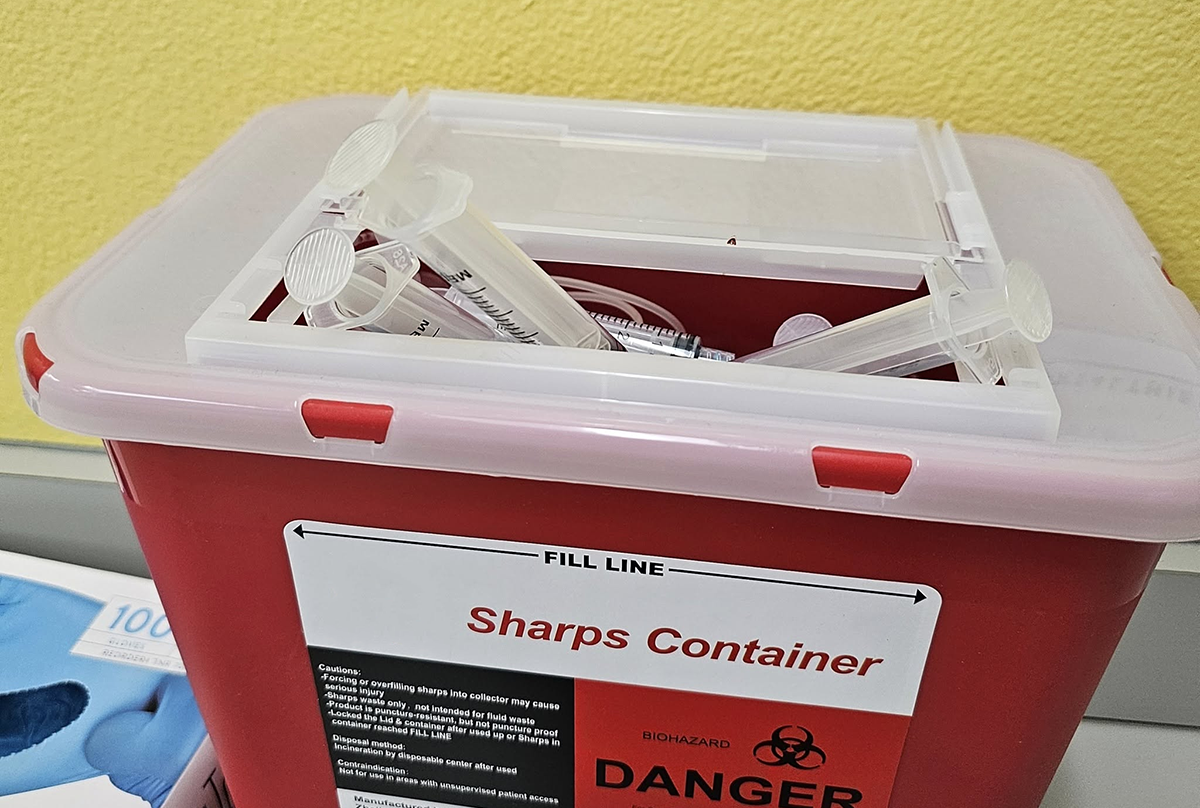
An overfilled sharps container is not a minor inconvenience — it is a preventable occupational hazard, a regulatory violation, and a serious infection control failure. When a sharps container exceeds its safe fill capacity, exposed needles, blades, and other sharps can protrude beyond the container opening, dramatically increasing the likelihood of needlestick injuries, cross-contamination, and non-compliant sharps waste disposal. For medical laboratories, hospitals, and healthcare distributors, understanding and preventing overfilling is a core component of sound sharps container safety protocols.
What Happens When a Sharps Container Is Overfilled?
When a sharps container reaches or exceeds its maximum fill line — typically marked at three-quarters (¾) full — several dangerous conditions develop simultaneously.
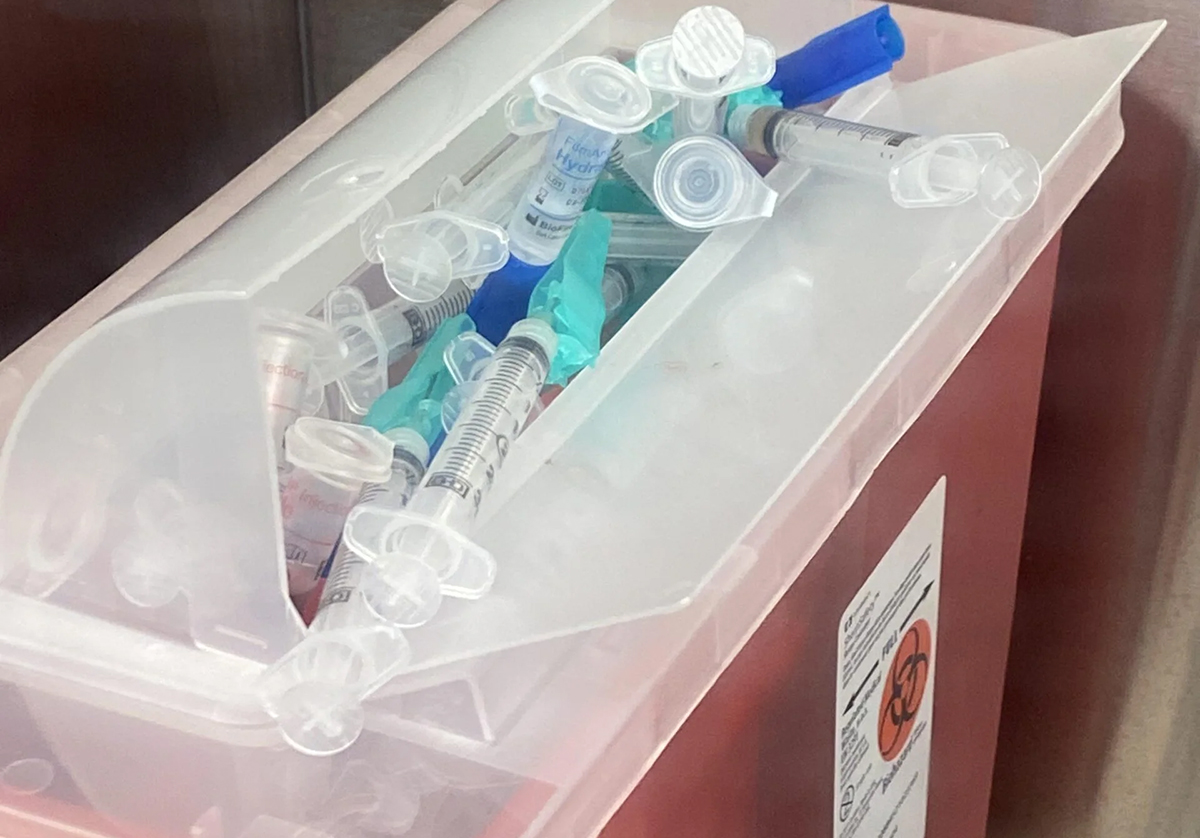
Sharps begin to protrude from the opening. As the container fills beyond capacity, needles, lancets, and scalpel blades crowd toward the aperture. Any subsequent attempt to deposit an additional sharp — or simply to move the container — risks direct skin contact with a contaminated point.
The lid can no longer close or lock securely. Most sharps containers are engineered with a temporary closure and a final lock-out mechanism. An overfilled container compromises both, leaving the contents exposed during handling, transport, and waste collection.
Container integrity is threatened. Puncture-resistant containers are designed to contain a defined volume at a specified weight. Overfilling can stress container walls, increase the risk of tipping, and — particularly in paper-based or lower-specification containers — compromise puncture resistance.
Documentation and chain-of-custody records become unreliable. Regulatory frameworks governing sharps disposal require containers to be sealed and labelled at the point of fill. An overfilled container that has been in use beyond its recommended capacity undermines compliance records.
For a comprehensive overview of container types, construction standards, and clinical applications, see our guide: Sharps Containers Explained: A Guide to Types, Sizes, and Clinical Applications
The Major Risks of Overfilled Sharps Containers
1. Increased Needlestick Injuries
Needlestick injuries are the primary occupational hazard associated with overfilled sharps containers. According to the World Health Organization (WHO), an estimated 2 million healthcare workers experience needlestick injuries annually worldwide, with a significant proportion attributable to improper sharps disposal practices — including the use of full sharps containers (WHO, Aide-Mémoire on Safe Injection Practices, 2016).
The U.S. Centers for Disease Control and Prevention (CDC) and the Occupational Safety and Health Administration (OSHA) both cite overfilling as a documented contributor to sharps-related injuries in healthcare settings. OSHA’s Bloodborne Pathogens Standard (29 CFR 1910.1030) explicitly requires that sharps disposal containers be “easily accessible to personnel and located as close as feasible to the immediate area where sharps are used” — and that they be replaced routinely and not allowed to overfill.
A landmark clinical study published in the American Journal of Infection Control (Trim & Elliott, 2003) found that a substantial portion of sharps injuries occurred during the disposal process itself, with container fill level identified as a modifiable risk factor.
For needlestick injury prevention, the fill line on a sharps container is not advisory — it is a safety threshold that must be treated as a hard stop.
2. Cross-Contamination and Infection Risks
Every needle or sharp deposited into a clinical container may carry blood-borne pathogens, including Hepatitis B Virus (HBV), Hepatitis C Virus (HCV), and HIV. HBV in particular can survive on environmental surfaces for up to seven days, making any surface contaminated by an exposed sharp a persistent transmission risk.
When a sharps container is overfilled:
- Contaminated sharps may contact the outer surface of the container
- Leakage of residual fluids becomes possible if the container is tipped or jostled
- Healthcare workers, cleaning staff, and waste handlers are exposed during routine handling
The risk extends beyond the original user. Laboratory technicians, nursing staff, porters, and downstream waste collection personnel all face exposure from a full sharps container that has not been properly sealed and replaced.
Under the International Organization for Standardization standard ISO 23907-1:2021, containers must maintain their protective integrity throughout their intended use cycle — a standard that overfilling directly violates.
3. Regulatory and Compliance Violations
Overfilled sharps containers represent a direct breach of multiple regulatory frameworks applicable to hospitals, medical laboratories, and distributors.
Key regulatory requirements include:
- OSHA 29 CFR 1910.1030 (USA): Bloodborne Pathogens Standard mandates that containers be maintained upright, not overfilled, and replaced when approaching full capacity.
- EPA Guidelines for Medical Waste: Classifies improperly contained sharps as regulated medical waste subject to enforcement action.
- EU Directive 2010/32/EU: Prevention of sharps injuries in the hospital and healthcare sector requires member states to ensure appropriate disposal containers are used and replaced before overfilling.
- WHO Safe Management of Wastes from Health-Care Activities (2nd Ed., 2014): Recommends replacement at ¾ capacity, with no exceptions for convenience or cost.
- ISO 23907-1:2021 and ISO 23907-2:2023: Specify performance requirements for sharps containers, which are predicated on proper fill management.
Regulatory violations resulting from overfilled sharps containers can lead to inspection failures, monetary fines, increased liability exposure, and — in severe cases — facility sanctions. For procurement officers and distributors supplying healthcare institutions, ensuring that container specifications and quantities support compliant fill management is a direct procurement responsibility.
4. Risks During Waste Collection and Transport
The risks of a full sharps container do not end at the point of clinical care. Waste handlers, transporters, and disposal facility personnel represent the downstream exposure chain.
During collection and transport:
- Unsecured containers may tip, spill, or rupture if overfilled and improperly sealed
- Compaction during waste transport (in non-rigid outer packaging) can drive exposed sharps through container walls
- Downstream workers who did not participate in sharps use are still at risk from improperly managed sharps waste disposal
Transportation of medical waste in many jurisdictions — including under IATA Dangerous Goods Regulations and UN 3291 packaging requirements for clinical waste — requires that sharps containers be sealed, non-leaking, and within rated capacity at the time of collection. An overfilled container that cannot be securely closed fails this requirement at the point of origin.
How Full Should a Sharps Container Be?
A sharps container should be replaced when it reaches the ¾ full mark — approximately 75% of its total volume capacity. This is the consensus threshold recommended by WHO, OSHA, the CDC, and virtually every national health authority with published sharps disposal guidance.
This threshold exists for practical reasons:
- Headspace above the fill line allows the temporary closure mechanism to function correctly
- Weight distribution remains within the container’s tested load rating
- Visual identification of a near-full container is clear to clinical staff before a hazardous condition develops
Never wait until the container is completely full. A container that appears “almost full” has already crossed the safety threshold. In high-volume settings — busy emergency departments, phlebotomy labs, dialysis units — containers may need replacement multiple times per shift.
For the question of how to dispose of a full sharps container: the container should be temporarily closed with its interim lid, then transported to a designated collection point for final sealing, labelling, and regulated sharps waste disposal through a licensed medical waste contractor. Under no circumstances should a full or overfilled container be emptied or consolidated manually.
For detailed guidance on what materials can and cannot be placed in a sharps container, refer to our clinical reference: What Can Be Placed in a Sharps Container: Clinical Guide to Sharps Disposal Compliance
Best Practices for Sharps Container Safety
Place Containers Near Point of Use
Sharps containers must be positioned at the point of care, not across the room. OSHA’s Bloodborne Pathogens Standard (29 CFR 1910.1030) requires containers to be “easily accessible” and located “as close as feasible” to where sharps are used. When containers are distant, the risk of recapping, carrying, or otherwise mishandling a used sharp increases significantly — all precursors to a needlestick injury.
For hospital wards, operating theatres, and medical laboratories, this means wall-mounted or trolley-mounted containers within arm’s reach of every procedure station.
Monitor Fill Levels Regularly
Implement a formal fill-level monitoring protocol. In high-use settings, containers should be visually checked at the start and end of each shift, and replaced proactively when the ¾ fill line is reached — or earlier in high-throughput environments.
For distributors supplying multi-site healthcare networks, recommending or providing a documented monitoring schedule as part of a sharps management program adds demonstrable value and supports client compliance.
Use Appropriate Container Sizes
Matching container size to clinical application is a key element of sharps container safety. Using an undersized container in a high-volume setting accelerates fill rate, increases the risk of overfilling between scheduled checks, and raises per-unit disposal costs.
Container size selection should account for:
- Volume of sharps generated per shift or per day at the specific point of use
- Physical dimensions compatible with wall-mount brackets or trolley holders
- Regulatory classification — some jurisdictions specify minimum container specifications for certain clinical environments
BiosafePro offers a full range of sharps containers in multiple sizes and configurations — from compact 0.5L point-of-care units to high-capacity 20L+ containers for high-throughput laboratory or surgical settings — all compliant with international standards.
Train Staff Continuously
Training is not a one-time event. Staff turnover, the introduction of agency workers, and procedural drift all erode safe sharps disposal practices over time. A sharps container safety program must include:
- Initial orientation training covering correct container use, fill thresholds, and replacement procedures
- Periodic refresher training, at minimum annually
- Incident-triggered retraining following any sharps-related near-miss or injury
- Visual reminders — signage at each container location reinforcing the ¾ fill rule
The Needlestick Safety and Prevention Act (USA, 2000) and EU Directive 2010/32/EU both include provisions requiring employers to provide training and implement safer sharps disposal practices — underscoring that training is a regulatory obligation, not merely a best practice.
Frequently Asked Questions
Can a sharps container be emptied and reused?
No. Sharps containers are single-use devices and must never be emptied or reused. Attempting to manually empty a sharps container exposes personnel to direct contact with contaminated needles, lancets, and blades — a serious needlestick injury risk with potential transmission of HBV, HCV, and HIV. Reuse also violates the design specification of the container: puncture-resistant integrity, closure mechanisms, and biohazard labelling are all validated for one complete use cycle only. Under OSHA 29 CFR 1910.1030 and equivalent international regulations, single-use sharps containers must be sealed and disposed of through a licensed sharps waste disposal contractor — not emptied, consolidated, or repurposed.
Who is most at risk from an overfilled sharps container?
Multiple groups face elevated risk from overfilled sharps containers, spanning the full chain from clinical use to final disposal. Nursing staff and phlebotomists face the highest point-of-care exposure, as they are most likely to attempt a deposit into an already-full container. Housekeeping and porter staff who handle and transport containers without direct clinical involvement are frequently injured because they may not recognize the fill-level hazard. Waste collection and transport workers are at risk downstream, particularly where overfilled containers cannot be properly sealed. Research published in Occupational and Environmental Medicine consistently identifies non-clinical ancillary staff as disproportionately represented in sharps injury statistics — precisely because they handle the container after the clinical risk has been created by overfilling.
What types of items should never be forced into a full sharps container?
Nothing should ever be forced into a sharps container that has reached or exceeded its fill line. Specifically, staff must not attempt to insert additional needles, syringes, IV cannulas, scalpel blades, lancets, or any other sharp into a container showing the ¾ fill indicator. Forcing items into a full container compresses existing contents unpredictably, increasing the likelihood that a sharp will reorient toward the opening or penetrate the container wall. Similarly, non-sharps items — such as medication vials, cotton swabs, or tubing — should never be used to “top off” space in a near-full container, as this masks the true fill level and adds unnecessary bulk. If the container is full, it must be replaced immediately. For clarity on which items are and are not appropriate for sharps containers in the first place, refer to our clinical guide: What Can Be Placed in a Sharps Container: Clinical Guide to Sharps Disposal Compliance
How often should sharps containers be inspected?
Sharps containers should be visually inspected at least at the start and end of every clinical shift — and more frequently in high-throughput settings such as phlebotomy laboratories, emergency departments, dialysis units, and operating theatres. Inspection should assess fill level against the marked indicator, physical integrity of the container body, security of the temporary closure, and correct positioning (upright, stable, and accessible). In settings with unpredictable sharps usage volumes, a designated staff member should be assigned responsibility for container checks as a formal task within infection control protocols. A container found at or near the ¾ fill line during any inspection should be replaced immediately, regardless of shift timing or schedule. Facilities operating under Joint Commission, ISO 15190, or equivalent accreditation standards are expected to document container management as part of their medical waste compliance records.
What should staff do if they discover an overfilled sharps container?
Staff who discover an overfilled sharps container should follow a clear, immediate response protocol:
- Do not attempt to add any further items to the container.
- Do not attempt to manually close the lid by pressing down on the contents — this is a primary cause of needlestick injuries in this scenario.
- Alert the relevant supervisor or infection control lead immediately and treat the container as an active sharps hazard.
- If the container has a partial closure mechanism that can be engaged without hand contact with the fill area, use it carefully to reduce exposure risk during movement.
- Place a secondary rigid outer container or approved sharps transport bag around the overfilled unit where available, to contain any protruding sharps during transfer.
- Arrange immediate collection by the licensed waste contractor and document the incident in the facility’s sharps safety log.
- Conduct a root cause review to determine why the container was allowed to overfill — whether due to inadequate monitoring, insufficient container size, or a lapse in staff training — and implement corrective action.
Overfilling incidents should be treated as near-miss events under occupational health and safety reporting frameworks, not as routine occurrences.
Home and Community Care Note: Safe sharps disposal is equally important outside clinical settings. Patients managing conditions such as diabetes who use insulin syringes at home face similar disposal risks. For guidance on safe at-home disposal, see: How to Dispose of Needles at Home: A Guide for Diabetes Patients
Conclusion
Overfilled sharps containers are a serious, well-documented, and entirely preventable safety risk. The consequences span three critical domains: clinical harm through needlestick injuries and infection transmission; regulatory exposure through violations of OSHA, EPA, EU, and WHO standards; and downstream risk to waste management personnel throughout the sharps waste disposal chain.
For hospitals, medical laboratories, procurement teams, and distributors, the imperative is clear: invest in correctly sized, compliant sharps containers, implement robust fill-monitoring protocols, replace containers at the ¾ fill threshold without exception, and ensure ongoing staff training.
Sharps container safety is not a cost center — it is a patient safety, staff safety, and regulatory compliance priority.
BiosafePro provides CE-certified sharps containers, waste management equipment, and expert compliance guidance to healthcare institutions and distributors worldwide. To discuss container specifications, volume requirements, or regulatory compliance for your procurement program, contact our team or request a product catalog.