


By BiosafePro Technical Editorial Team | Biomedical Waste Management Specialists
BiosafePro est un fabricant d'équipements médicaux spécialisés dans la technologie de décontamination environnementale, la stérilisation à haute température au moyen de vapeur, la désinfection par micro-ondes et les systèmes de traitement chimique destinés aux établissements de santé, aux laboratoires et aux opérateurs de gestion des déchets à l'échelle mondiale.
Medical waste autoclave capacity defines how much infectious or regulated medical waste a single treatment cycle can hold or process (measured in liters, cubic meters, or medical waste autoclave kg per cycle), whereas autoclave throughput measures how much waste the system treats over a given operating period (commonly medical waste autoclave kg/h, medical waste autoclave kg per hour, or kg/day) (Source: World Health Organization, Safe Management of Wastes from Health-Care Activities). Confusing these two metrics is one of the most frequent—and costly—mistakes in hospital waste management and regional distributor tender bidding.
In clinical and laboratory operations, autoclave capacity vs throughput comes down to batch volume versus time-normalized output. A unit with a large medical waste autoclave cycle capacity can still deliver low medical waste autoclave hourly throughput if loading, vacuum air removal, steam penetration, holding, depressurization, and cooling take 75 to 90 minutes per run (Source: U.S. CDC, Guidelines for Environmental Infection Control in Health-Care Facilities). Conversely, a mid-sized chamber running shorter, well-loaded cycles across an 8- to 16-hour shift can match or exceed the daily output of an oversized chamber operated intermittently.
Healthcare waste volumes continue to expand alongside outpatient care, diagnostics, and single-use clinical consumables. According to the World Health Organization, approximately 15% of total healthcare waste is hazardous material that may be infectious, toxic, or radioactive, and global healthcare waste generation has risen steadily with clinical service expansion (Source: WHO Healthcare Waste Fact Sheet). For procurement teams and distributors comparing medical waste autoclave capacity and throughput, sizing around real daily waste generation, cycle duration, and realistic equipment utilization protects both compliance and total cost of ownership (TCO).
Medical Waste Autoclave Capacity: How Much Waste Can One Cycle Handle?
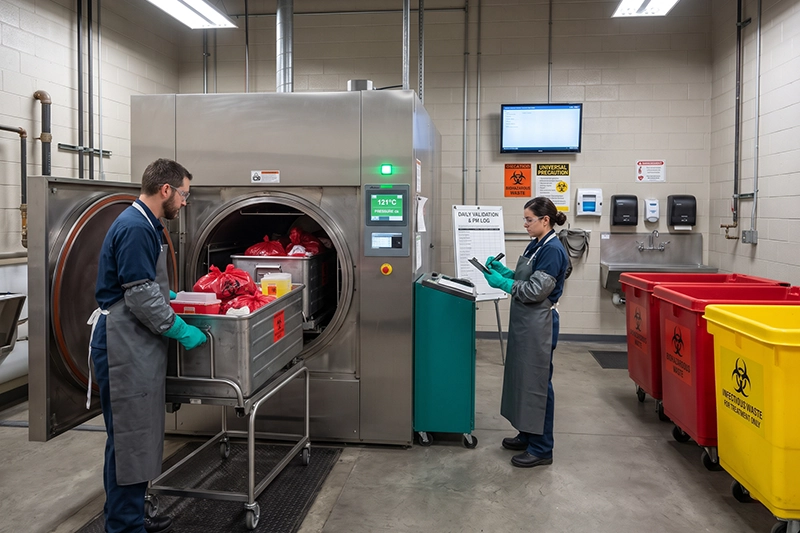
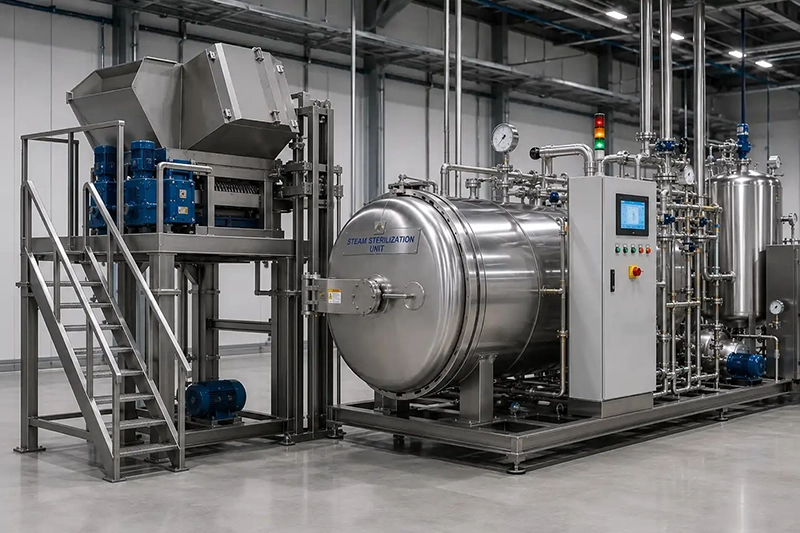
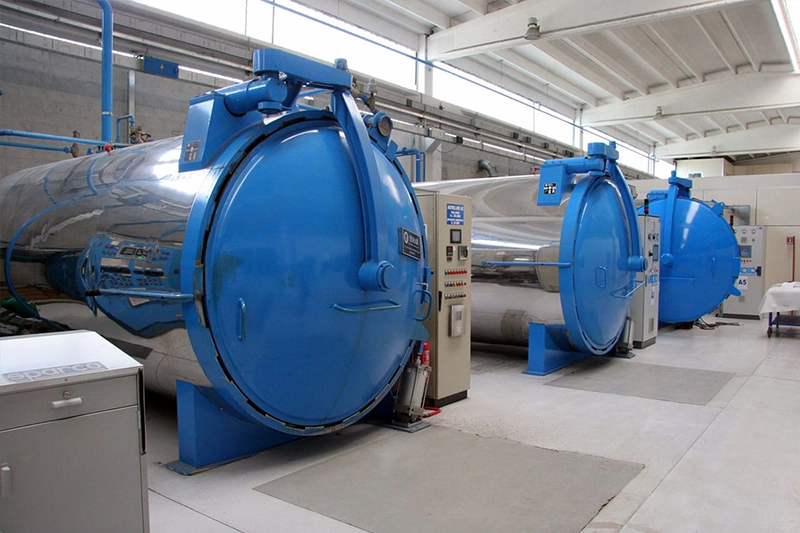
Autoclave capacity describes the physical or mass limits of a single operating batch inside a Autoclave pour déchets médicaux (Source: WHO, Safe Management of Wastes from Health-Care Activities). When evaluating medical waste autoclave capacity kg, buyers encounter three distinct specifications that should never be treated as interchangeable:
- Chamber volume (L or m³): The internal geometric volume of the pressure vessel—for example, 100 L to 500 L for laboratory or smaller clinical units, and 1 m³ to 10+ m³ for central hospital or regional treatment plants (Source: WHO, Safe Management of Wastes from Health-Care Activities). Geometric volume alone does not guarantee usable waste mass because baskets, carts, air space, and non-uniform bag packing reduce usable fill volume.
- Load capacity (kg/cycle): The maximum permissible gross weight of waste bags, rigid containers, or carriers placed into the chamber for one batch, typically constrained by tray/cart structural ratings, steam circulation clearances, and vessel design limits (Source: ASME Boiler and Pressure Vessel Code, Section VIII).
- Processing capacity (kg/cycle): The practical mass of regulated medical waste effectively treated to validated microbial inactivation in a single cycle under specified loading density, moisture, and packaging conditions (Source: S. EPA, Medical Waste Incineration and Steam Sterilization Guidance).
Because waste streams vary from low-density sharps/plastic laboratory consumables to denser anatomical or mixed clinical waste, medical waste autoclave capacity per cycle depends heavily on packing density and steam penetration. Under standard steam sterilization protocols, validated cycles typically operate at 121℃ (250℉) for at least 30 minutes or 134℃–135℃ (273℉–275℉) for shorter exposure intervals once core load temperature is reached (Source: U.S. CDC, Guidelines for Environmental Infection Control in Health-Care Facilities). Overpacking a chamber beyond its validated medical waste autoclave treatment capacity per batch can trap air pockets, slow heat transfer to the center of the load, and compromise sterilization validation.
For facilities evaluating chamber architectures and cycle designs, technical details on steam treatment configurations are outlined in the BiosafePro high-temperature steam treatment overview, which covers steam sterilization principles and integrated treatment setups.
What Does Autoclave Throughput Mean?
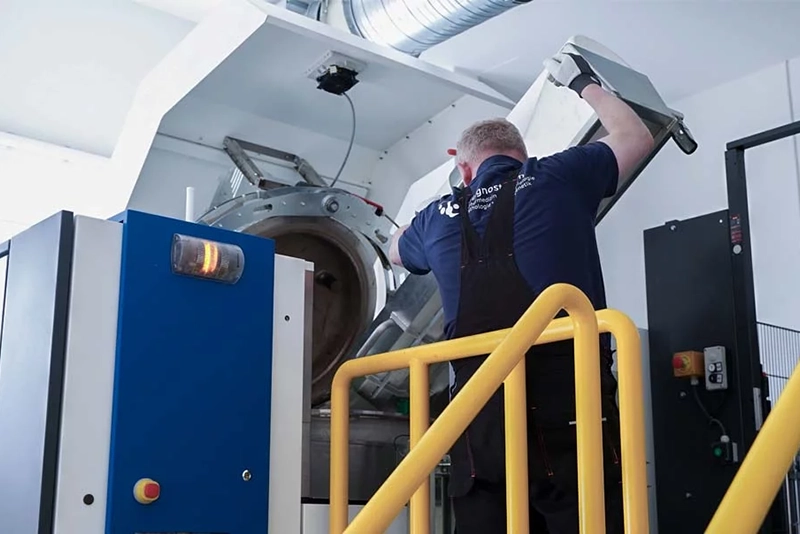
Autoclave throughput—also referred to as medical waste autoclave throughput ou medical waste autoclave processing capacity—measures the quantity of waste treated over a defined period of time (Source: WHO, Safe Management of Wastes from Health-Care Activities). Rather than describing a single batch, throughput reflects real operational output across consecutive cycles.
Buyers typically see autoclave treatment capacity kg/h expressed in three units:
- kg/hour: Useful for comparing continuous or multi-cycle hourly capability under standardized cycle times (for example, 30 kg/h to 250+ kg/h depending on chamber size and cycle structure) (Source: WHO, Safe Management of Wastes from Health-Care Activities).
- kg/day: The practical daily treatment volume achieved across scheduled shifts, accounting for warm-up, cycle intervals, loading/unloading, and routine daily checks.
- tonnes/day: Common for centralized hospital hubs or regional treatment facilities handling 1 to 10+ tonnes/day of infectious waste (Source: WHO, Safe Management of Wastes from Health-Care Activities).
A simplified relationship for estimating medical waste autoclave hourly throughput is:
Throughput (kg/h) ≈ Waste processed per cycle (kg) / Total cycle time (hours)
Where Total cycle time includes vacuum/air evacuation, steam heating, exposure/holding time, depressurization/exhaust, drying/cooling where applicable, and door/transfer handling—not merely the sterilization hold timer (Source: U.S. CDC, Guidelines for Environmental Infection Control in Health-Care Facilities).
Capacity vs Throughput: The Key Difference
Understanding the difference between autoclave capacity and throughput prevents spec-sheet mismatches during hospital procurement and distributor tender evaluations. Capacity is a per-batch rating; throughput is a time-rate performance metric driven by both batch mass and total cycle time.
| Parameter | What it tells you | Common unit |
| Autoclave capacity | How much waste can be processed in one cycle | L/cycle or kg/cycle |
| Autoclave throughput | How much waste can be processed over time | kg/hour or kg/day |
| Cycle time | How long one complete treatment cycle takes | minutes/cycle |
| Daily processing capacity | Expected waste treatment over a working day | kg/day or tonnes/day |
A facility may purchase a 200 kg/cycle unit, yet achieve only 100 kg/hour if each complete cycle requires 2 hours from start to unload. Conversely, a 120 kg/cycle unit completing a 45-minute (0.75 hour) total cycle yields 160 kg/hour theoretically—and roughly 120–135 kg/hour once realistic loading and interval buffers are included.
Why a Larger Autoclave Does Not Always Mean Higher Throughput
A common assumption in autoclave capacity vs throughput comparisons is that a bigger chamber automatically delivers higher hourly or daily output. In practice, larger chambers often introduce thermal and mechanical trade-offs:
- Longer heat-up and air-removal phases: Larger volumes of air and heavier steel/waste loads take longer to evacuate and bring uniformly to target steam temperature (Source: U.S. CDC, Guidelines for Environmental Infection Control in Health-Care Facilities).
- Longer cooling and depressurization times: High-volume chambers require more time to safely relieve pressure and cool loads to safe handling temperatures before unloading.
- Batch accumulation delays: If a hospital ward or laboratory generates 80 kg of waste per shift but waits to fill a 400 kg chamber, batches sit longer between runs, lowering real medical waste autoclave throughput and delaying waste turnaround.
- Higher utility and footprint demands: Oversized chambers consume more steam, water, power, and floor space per cycle—especially when run partially empty—increasing operating costs without improving hourly output (Source: WHO, Safe Management of Wastes from Health-Care Activities).
“Selecting treatment equipment solely by maximum chamber volume without modeling waste generation rates, cycle durations, and realistic operating hours frequently leads to underutilized capital assets or operational bottlenecks during peak waste periods.”
— Adapted from World Health Organization, Safe Management of Wastes from Health-Care Activities
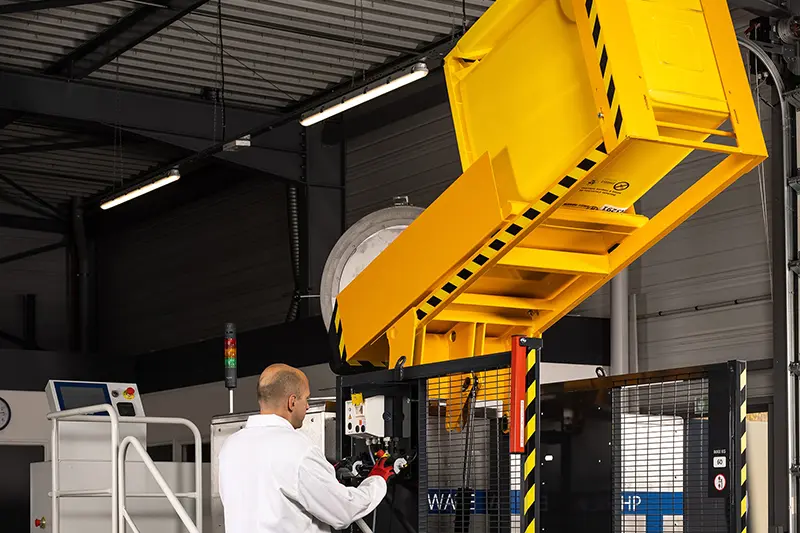
When evaluating whether pre-treatment or post-treatment size reduction fits a workflow, buyers can also review whether a medical waste autoclave with shredder is worth it alongside standard cycle-time trade-offs.
How Should Buyers Calculate the Required Throughput?
Rather than picking a chamber size from a catalog table, procurement teams and distributors should calculate required medical waste autoclave throughput from operational data using five inputs:
- Waste generated per day: Audit actual daily infectious/regulated waste mass (in kg/day) across departments, accounting for seasonal surges or surgical/lab peaks (Source: WHO, Safe Management of Wastes from Health-Care Activities).
- Required operating hours: Define how many hours per day the autoclave will run (for example, 6 to 8 hours on a single shift or 12 to 16 hours across extended shifts), leaving time for preventive maintenance and cleaning.
- Load capacity: Determine realistic usable waste mass per batch (kg/cycle) based on bag/bin density and validation limits rather than theoretical maximum weight.
- Complete cycle time: Use full cycle-to-cycle duration (in minutes or hours), including loading, conditioning, sterilization hold, exhaust/cooling, and unloading.
- Expected utilization: Apply a practical utilization factor (commonly 70% to 85% of theoretical maximum run time) to absorb waste collection lag, batch staging, and minor operational delays.
Worked Sizing Example
Suppose a mid-sized hospital generates 600 kg/day of regulated medical waste and plans to operate the unit for 8 hours/day with an 80% practical utilization factor (6.4 effective operating hours/day). Required average daily/hourly output is 600 kg ÷ 6.4 h ≈ 93.8 kg/h of effective capacity during active hours (or 75 kg/h averaged across the full 8-hour window). If a validated load holds 100 kg/cycle and each complete cycle takes 60 minutes (1.0 hour), the system can complete roughly 6 cycles in an 8-hour shift—up to 600 kg/day at full batch loading, or 480–500 kg/day at 80%–85% fill consistency. If daily waste reaches 750 kg/day, buyers should evaluate either shorter validated cycles, a second shift, a higher-throughput model, or additional capacity.
For budgeting and tender planning, cost drivers across chamber sizes and configurations are detailed in medical waste autoclave price and what affects the cost.
Capacity and Throughput Should Match the Project, Not Just the Machine
Matching medical waste autoclave capacity and throughput to a project requires aligning equipment specs with facility layout, waste logistics, and regulatory rules:
- Small clinics and specialized medical laboratories: Often prioritize compact footprint, batch flexibility, and cycle repeatability over massive daily tonnage; moderate kg/cycle capacity with predictable cycle times prevents waste holding delays.
- General hospitals: Need medical waste autoclave treatment capacity aligned with daily ward/OR/lab generation, storage room limits, and shift schedules so infectious waste does not accumulate beyond safe holding windows (Source: WHO, Safe Management of Wastes from Health-Care Activities).
- Centralized or regional treatment facilities & distributors: Focus heavily on autoclave treatment capacity kg/h and kg/day, uptime reliability, spare parts availability, and serviceability across continuous multi-cycle operation.
Sourcing Medical Waste Autoclaves for Different Capacity Requirements
When sourcing systems for end users or distributor portfolios, procurement teams should verify documentation across technical, compliance, and commercial criteria:
- Validated cycle parameters: Confirm temperature/pressure profiles, cycle time breakdowns, and biological/chemical indicator validation data under realistic waste loads (Source: U.S. CDC, Guidelines for Environmental Infection Control in Health-Care Facilities).
- Quality and safety standards: Check pressure-vessel compliance and quality management certifications such as ISO 13485:2016 and applicable pressure equipment directives (Source: ISO 13485:2016).
- Configuration options: Compare chamber styles, automation levels, and treatment configurations using medical waste autoclave types, features, and applications to match local waste streams and tender specifications.
- Lifecycle support and TCO: Evaluate warranty terms, commissioning support, replaceable seals/heaters/valves, and lead times to keep medical waste autoclave processing capacity running reliably after installation.
FAQ
Q: Does a larger chamber always provide higher throughput?
No. A larger chamber increases potential medical waste autoclave capacity per cycle, but longer heating, air-evacuation, and cooling times—or waiting for enough waste to fill a large batch—can result in equal or lower medical waste autoclave hourly throughput than a smaller, faster-cycling unit (Source: U.S. CDC, Guidelines for Environmental Infection Control in Health-Care Facilities).
Q: What is more important for a hospital: capacity or throughput?
Both matter, depending on the bottleneck. Capacity (kg/cycle) determines how much waste fits into a single batch, while throughput (kg/h or kg/day) determines whether the unit can clear the hospital’s daily waste volume within scheduled shift hours without backlogs (Source: WHO, Safe Management of Wastes from Health-Care Activities).
Q: Should buyers compare kg/cycle or kg/hour?
Compare both together, anchored to kg/day demand. Comparing kg/cycle alone ignores cycle duration; comparing kg/hour alone can overlook batch size limits for bulky or dense loads. Dividing kg/cycle by total cycle time gives a realistic baseline for kg/hour.
Q: Why does waste density matter when comparing autoclave capacity?
Waste density affects both physical loading and steam penetration. Low-density waste (such as light plastics or lab disposables) may hit chamber volume limits before reaching weight limits, while dense or tightly packed waste can restrict steam flow and require longer conditioning or smaller batch weights to achieve validated sterilization (Source: U.S. EPA, Medical Waste Incineration and Steam Sterilization Guidance).
Q: Should throughput be calculated using the sterilization time only?
No. Using only the sterilization hold time overestimates medical waste autoclave throughput because a complete cycle also includes vacuum/air removal, ramp-up to temperature, depressurization/cooling, and loading/unloading intervals (Source: U.S. CDC, Guidelines for Environmental Infection Control in Health-Care Facilities).
À propos de BiosafePro
BiosafePro is a manufacturer of medical waste treatment and biosafety equipment established in 2016, offering medical waste autoclaves, microwave/steam treatment systems, sharps and biohazard containers, and waste transport solutions certified to ISO 13485 and CE standards, exported to over 60 countries worldwide.
Planning a hospital waste upgrade or preparing a distributor tender? Contact the BiosafePro technical team today to review chamber sizing, throughput calculations, and tailored medical waste autoclave specifications for your project.
Références
- World Health Organization (WHO). Safe Management of Wastes from Health-Care Activities and Health-Care Waste Fact Sheet.
- Centers for Disease Control and Prevention (CDC). Guidelines for Environmental Infection Control in Health-Care Facilities.
- S. Environmental Protection Agency (EPA). Guidance for Evaluating Medical Waste Treatment Technologies, Final Report, Part 4: Steam Autoclave Treatment.
- ISO 13485:2016 — Medical devices — Quality management systems — Requirements for regulatory purposes.
- American Society of Mechanical Engineers (ASME). Boiler and Pressure Vessel Code, Section VIII.